Key Takeaways
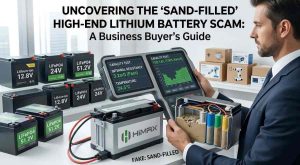
For business buyers, a lithium battery is not just a component. It is a safety-critical power source that affects product reliability, warehouse operations, after-sales costs, brand reputation, and customer trust. The so-called “sand-filled” high-end lithium battery scam is one of the most dangerous forms of battery fraud because the product may look normal from the outside, feel heavy in the hand, and even carry a convincing label. However, inside the pack, low-grade cells, recycled cells, fake capacity cells, poor wiring, or even weight-filling materials may be used to imitate the feel of a premium battery.
This guide explains how business buyers can identify suspicious lithium battery suppliers, avoid low-quality or counterfeit battery packs, verify technical documents, and build a more reliable procurement process. Whether you are purchasing batteries for industrial equipment, medical devices, robotics, solar energy storage, security systems, e-mobility products, or OEM projects, the right supplier screening process can help you prevent costly failures before they reach your customers.
Why the “Sand-Filled” Battery Scam Matters to Business Buyers
In consumer markets, a fake battery may cause frustration. In business procurement, it can cause product recalls, delayed shipments, warranty claims, damaged equipment, fire hazards, and long-term loss of customer confidence. That is why enterprise buyers need to treat battery sourcing as a technical risk-control process, not just a price comparison.
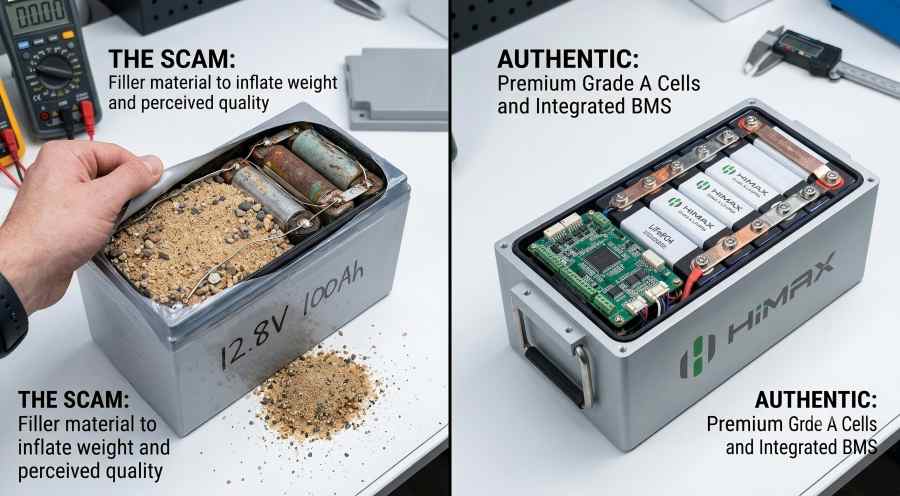
The “sand-filled” lithium battery scam refers to a broader problem in the battery supply chain: some sellers use physical weight, attractive labels, inflated capacity ratings, or incomplete test reports to make a low-quality battery look like a high-end product. In some extreme cases, fake or poorly assembled packs may include filler materials to make the product heavier. In other cases, the “sand-filled” problem is not literal sand, but a similar deception: the buyer pays for premium capacity, high-cycle cells, and certified protection, yet receives a battery pack that cannot deliver the promised performance.
For a procurement team, the danger is that many of these issues do not appear during a quick visual inspection. A fake battery pack can have a clean PVC wrap, a professional-looking label, and a voltage reading that seems acceptable at first. The problems often appear later: rapid voltage drop under load, overheating during charge and discharge, capacity far below the label, inconsistent cycle life, swollen cells, unstable BMS behavior, or sudden pack failure in the field.
Common Warning Signs of a Low-Quality or Fake Lithium Battery Supplier
- The first red flag is a price that is too low for the stated chemistry, capacity, and certification level. If a supplier claims to offer a premium lithium-ion or LiFePO4 battery pack at a price far below the market average, buyers should ask how that price is possible. Real battery costs include certified cells, BMS design, copper/nickel materials, housing, connectors, testing, labor, packaging, compliance documentation, and quality control.
- The second warning sign is vague technical information. A reliable battery manufacturer should be able to explain cell brand or cell grade, nominal voltage, rated capacity, energy in watt-hours, discharge current, peak current, charging method, operating temperature range, cycle life test conditions, BMS functions, housing material, connector specifications, and applicable safety tests. If the supplier only repeats “high quality,” “factory price,” or “Grade A cells” without details, that is not enough for business procurement.
- The third warning sign is inconsistent documentation. If the label says one capacity, the datasheet says another, and the test report shows a different model number, the buyer should pause the order. For business buyers, documentation must match the exact battery model, cell configuration, chemistry, voltage, capacity, and production batch whenever possible.
- The fourth warning sign is resistance to third-party inspection. A serious supplier should understand that enterprise buyers may request sample testing, factory audits, batch inspection, pre-shipment inspection, or third-party lab verification. If a supplier becomes defensive when you ask for a capacity test, internal resistance test, UN 38.3 test summary, MSDS, or relevant safety documentation, that is a major procurement risk.
What Business Buyers Should Test Before Bulk Orders
Before placing a bulk lithium battery order, buyers should always start with sample validation. A proper sample test should go beyond appearance and open-circuit voltage. At minimum, the procurement or engineering team should check actual capacity under a realistic discharge rate, voltage stability under load, charging performance, surface temperature, BMS protection response, connector quality, welding consistency, and pack weight consistency.
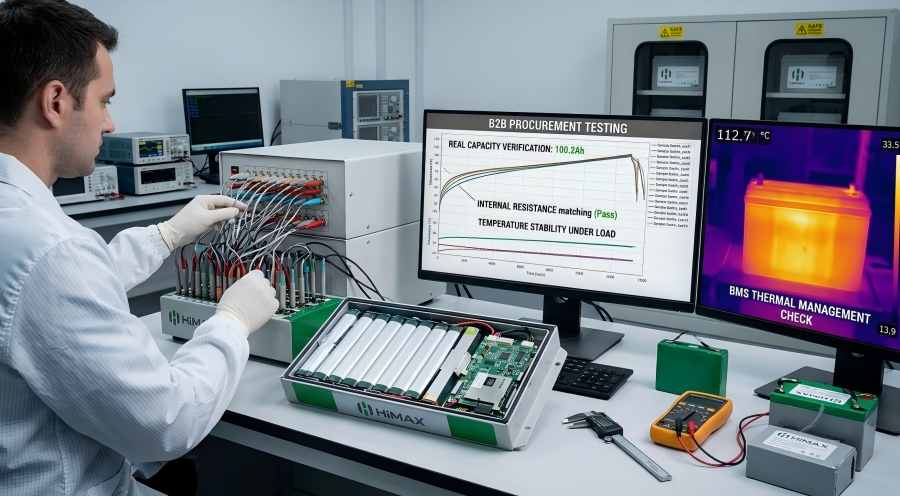
For example, if a supplier offers a 12.8V 100Ah LiFePO4 battery for an industrial backup system, the buyer should not only check whether the pack shows 13V when fully charged. The real question is whether it can deliver close to 100Ah under the agreed discharge condition, maintain safe temperatures, cut off properly under over-discharge or over-current conditions, and perform consistently across multiple samples.
Internal resistance is also important. High internal resistance may indicate poor cells, aged cells, mismatched cells, or weak pack assembly. In real applications, this can lead to voltage sag, lower usable capacity, heating, and reduced service life. For business buyers, testing one perfect-looking sample is not enough. You should test several samples from the same batch and compare consistency.
If the battery will be used in regulated, safety-sensitive, or high-value equipment, buyers should also consider destructive testing, thermal testing, vibration testing, drop testing, and long-cycle aging tests depending on the application. These tests take more time, but they can prevent serious downstream losses.
Case Study 1: Warehouse Robotics Battery Procurement
A logistics company in Texas operates 60 autonomous mobile robots in a 280,000-square-foot warehouse. Each robot uses a 24V 40Ah lithium battery pack and runs two shifts per day. The purchasing team receives an offer that is 22% cheaper than its current supplier. The datasheet claims high-cycle cells, fast charging, and advanced BMS protection.
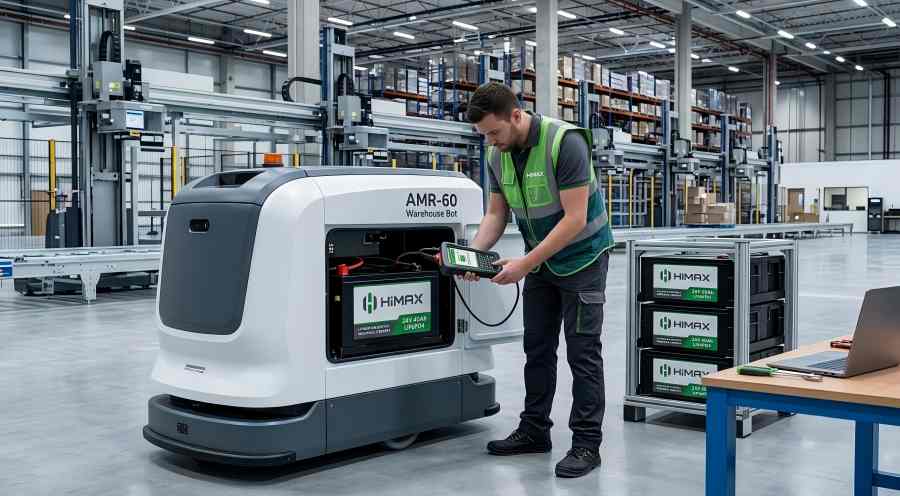
Instead of switching immediately, the company orders 10 samples and runs a 30-day validation test. The engineering team tests discharge at 0.5C and 1C, checks surface temperature during fast charging, reviews BMS cutoff behavior, and compares usable capacity after repeated cycles. The results show that three packs deliver only 72% to 78% of rated capacity under real operating conditions. Two packs show abnormal voltage sag when robots accelerate with a full load.
The lower purchase price would have saved money upfront, but the real cost would have been robot downtime, missed fulfillment targets, and emergency battery replacement. By testing before bulk purchasing, the company avoids a supplier that looked attractive on price but failed in real operations.
Case Study 2: Solar Energy Storage for Commercial Buildings
A commercial solar installer in California is sourcing 51.2V 200Ah LiFePO4 battery modules for small business backup systems. The supplier claims each module uses premium cells and provides over 6,000 cycles. The buyer asks for cycle life conditions, cell specification, BMS details, UN 38.3 documentation, and a production quality control report.
The supplier provides a generic certificate with no matching model number and cannot explain the test conditions behind the cycle life claim. The installer then requests two sample modules for lab testing. During capacity testing at room temperature, one module performs close to specification, but the second delivers significantly less usable energy. After opening the casing under controlled inspection, the internal layout and cell markings do not match the supplier’s original claim.
For a commercial solar installer, this is a critical finding. A battery system installed in a customer’s building must perform safely and predictably over years of use. A low-quality module can damage the installer’s reputation and create warranty exposure far greater than the initial battery cost.
Case Study 3: Medical Device Backup Battery Sourcing
A medical equipment company in Illinois needs a custom lithium battery pack for a portable diagnostic device. The device requires stable output, clean assembly, traceable materials, and consistent batch quality. A low-cost supplier offers a pack with the same voltage and capacity at a much lower price.
The company’s engineering team requests traceability records, cell lot information, protection circuit details, charge-discharge curves, and production inspection data. The supplier cannot provide complete records and avoids answering questions about cell origin. The buyer rejects the supplier before mass production.
In medical applications, even a small battery failure can interrupt service, create liability concerns, and damage trust with hospitals or clinics. For this type of buyer, supplier reliability is not optional. It is part of the product’s safety foundation.
How to Screen a Reliable Lithium Battery Supplier
A reliable lithium battery supplier should be transparent, technically capable, and willing to support verification. Start with the basics: business license, factory profile, manufacturing capabilities, engineering team, production equipment, testing equipment, quality control process, and export experience.
Next, evaluate technical communication. A qualified supplier should ask about your application, working current, peak load, charging environment, installation space, expected runtime, temperature range, connector requirements, casing design, certification needs, and shipping destination. If the supplier gives a quote before understanding your application, the solution may not be properly engineered.
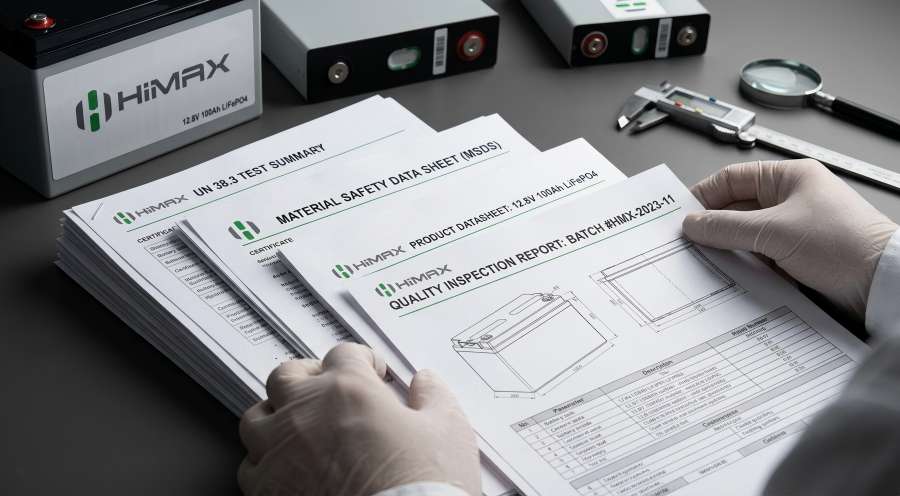
Then verify documents carefully. Ask for datasheets, safety test reports, UN 38.3 test summary when required for transport, MSDS, quality inspection reports, and relevant certifications. Make sure the model number, voltage, capacity, chemistry, and manufacturer information match your purchase order and sample.
Finally, build a staged procurement process. Do not move from inquiry to bulk order too quickly. A safer process includes supplier qualification, sample order, engineering test, pilot order, batch inspection, pre-shipment inspection, and long-term supplier performance review.
Practical Checklist for Business Battery Buyers
Before confirming a lithium battery order, ask these questions:
What cell chemistry is being used: Li-ion, LiFePO4, lithium polymer, or another chemistry?
What is the real rated capacity under specified test conditions?
What is the continuous discharge current and peak discharge current?
What protection functions are included in the BMS?
Can the supplier provide matching technical documents for the exact model?
Is there a clear warranty policy based on real operating conditions?
Can the supplier support custom design, batch traceability, and pre-shipment inspection?
Has the sample passed capacity, load, temperature, and safety checks?
Are the battery dimensions, weight, connector, and housing consistent across samples?
Does the supplier understand the requirements of your target market?
If the supplier cannot answer these questions clearly, the risk is not just a bad purchase. It may become a product quality problem, a safety issue, or a brand reputation problem.
Final Thoughts: Protect Your Business Before the Battery Reaches Your Customers
The “sand-filled” high-end lithium battery scam is a reminder that battery purchasing requires technical verification. A battery may look professional from the outside, but true quality is proven by design, materials, testing, documentation, and consistent performance in real applications.
For enterprise buyers, the safest strategy is simple: do not trust appearance, weight, or marketing claims alone. Test samples, verify documents, inspect batches, and choose suppliers who can explain the engineering behind their products. A reliable lithium battery supplier should help you reduce risk, not create uncertainty.
About HiMAX Battery
HiMAX is a professional battery manufacturer serving global customers with reliable lithium battery solutions for industrial, commercial, and custom applications. We support OEM and ODM battery projects with engineering design, battery pack assembly, BMS integration, quality control, and application-focused technical support.
From LiFePO4 battery packs and lithium-ion battery solutions to custom power systems for robotics, energy storage, medical devices, security equipment, portable electronics, and industrial tools, HiMAX is committed to helping business buyers source batteries with confidence. Our team focuses on stable performance, safety-conscious design, reliable production, and long-term customer value.
Find articles related to Lithium-ion Battery
- Price Comparison of 6 Common Lithium-Ion Battery Voltages (3.7V–22.2V)
- Lithium-ion Battery Classification Guide: Exploring Chemical Compositions, Common Sizes, and Application Scenarios
- Lithium-Ion Battery Packs vs. Cells: Differences & Application Scenario Exploration
Responding to Amazon US Lithium Battery Compliance Upgrades: Supply Chain Tech Guide