Key Takeaways
Swollen Li-polymer cells are not only a product defect. They are often a sign of deeper problems in battery design, sourcing, production control, storage, charging, or application matching.
Enterprise procurement teams can reduce Li-polymer battery failure by choosing the right supplier, confirming the right battery chemistry, checking real operating conditions, and requiring strict quality control before bulk orders ship.
A low unit price can become expensive if the battery has swelling, capacity loss, unstable discharge, short cycle life, safety risk, or high return rates.
The most important procurement steps include defining electrical parameters, matching the battery to the device load, reviewing protection circuit design, checking cell consistency, confirming certifications, and testing pilot samples before mass production.
For companies buying Li-polymer batteries in bulk, smart sourcing is not just about purchasing. It is about risk control, product reliability, customer safety, and long-term brand trust.
Why Swollen Li-Polymer Cells Matter in Enterprise Procurement
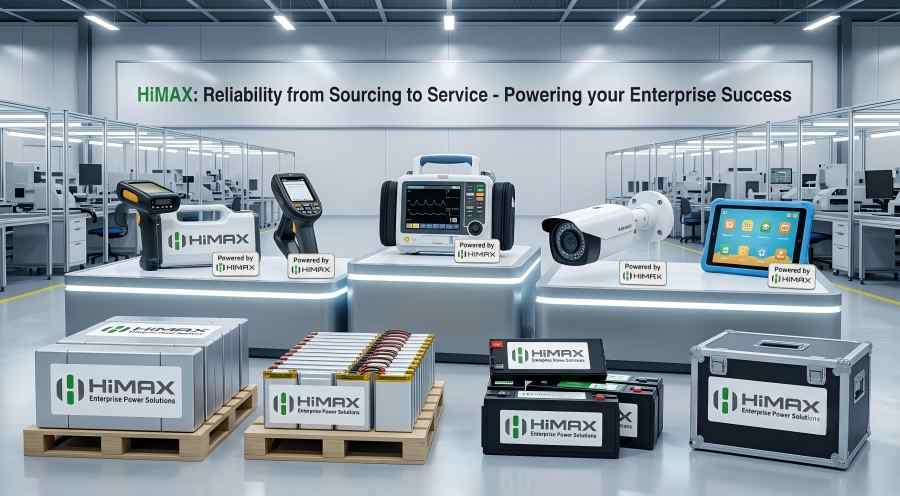
A swollen Li-polymer battery can create serious problems for a business. It can damage the product housing. It can reduce device runtime. It can increase warranty claims. It can also create safety concerns for customers, technicians, warehouse teams, and transportation partners.
For enterprise buyers, swelling is not just a battery issue. It is a procurement issue. It often starts before the order is placed. A buyer may choose the wrong cell size. A product team may underestimate the peak current. A supplier may use unstable materials. A charger may not match the pack design. A warehouse may store batteries at high temperatures for too long.
These small decisions can turn into large problems when a company places a bulk order. One failed sample is easy to replace. Ten thousand swollen cells can delay production, damage customer trust, and increase total project cost.
That is why enterprise procurement teams need a smarter way to source Li-polymer batteries. The goal is not only to find a supplier. The goal is to find the right battery solution for the device, the environment, the charging system, and the expected product life cycle.
What Causes Li-Polymer Battery Swelling?
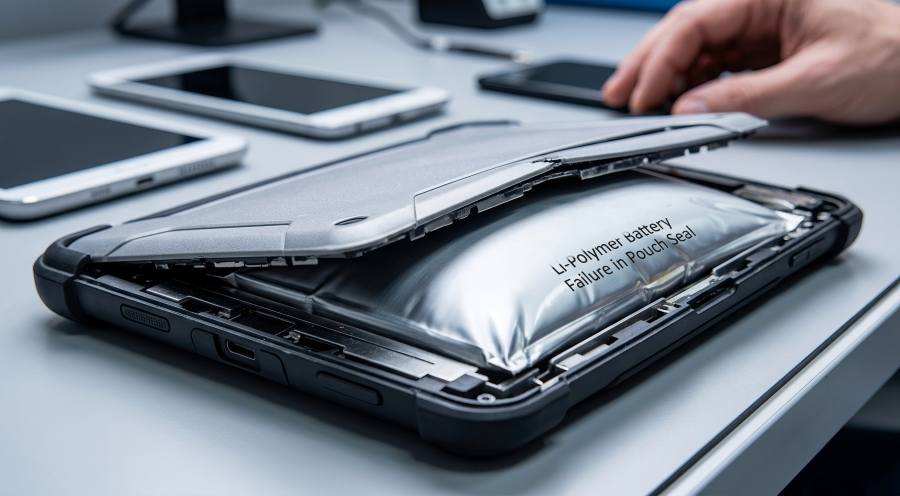
Li-polymer battery swelling usually happens when gas builds up inside the pouch cell. This can be caused by chemical reactions inside the battery. These reactions may become worse under stress, heat, overcharging, over-discharging, poor cell quality, or wrong application design.
Several common causes include:
- Poor cell manufacturing control. If the cell has inconsistent coating, moisture contamination, weak sealing, unstable electrolyte, or poor material control, the battery may fail earlier than expected.
- A Li-polymer cell needs proper voltage control. If the charging voltage is too high, the internal chemistry may become unstable. This can increase gas generation and swelling risk.
- Over-discharging. When the cell voltage drops too low, the battery can suffer internal damage. If the device does not have proper protection, the battery may become unsafe or unreliable after repeated deep discharge.
- High operating temperature. Heat speeds up battery aging. A device used in hot environments, near motors, under direct sunlight, or inside a sealed plastic enclosure may place extra stress on the cell.
- High discharge current. If the device pulls more current than the cell is designed to handle, the battery may heat up, lose capacity faster, and become more likely to swell.
- Long storage at full charge. Bulk batteries stored for months at high state of charge can age faster, especially if the warehouse temperature is high.
- Wrong protection circuit design. A Li-polymer pack needs proper PCM or BMS design. The protection system should control overcharge, over-discharge, overcurrent, short circuit, and temperature risk when required by the application.
The Real Cost of Choosing the Wrong Li-Polymer Battery Supplier
Many companies focus on unit price during battery sourcing. This is understandable because batteries can be a large part of the total bill of materials. However, the cheapest Li-polymer battery can become the most expensive option if it causes field failures.
A low-cost supplier may look attractive in the quote stage. But if the cells have poor consistency, weak cycle life, unstable capacity, or poor protection design, the cost appears later.
The hidden costs may include:
- Product returns from customers.
- Device repair or replacement.
- Delayed production schedules.
- Extra incoming inspection labor.
- Emergency air freight for replacement packs.
- Damage to brand reputation.
- Retailer or distributor penalties.
- Safety review and compliance issues.
- Lost customer trust in the final product.
Enterprise procurement should measure total cost, not only battery price. A better battery supplier can reduce failure risk, improve product experience, and help the business protect long-term margins.
How Procurement Teams Should Define Li-Polymer Battery Requirements
Before asking for a quote, a company should prepare a clear battery requirement sheet. This step is critical because a vague request often leads to the wrong recommendation.
A strong requirement sheet should include:
- Nominal voltage.
- Capacity in mAh or Wh.
- Maximum continuous discharge current.
- Peak discharge current and duration.
- Charging current and charging voltage.
- Required dimensions and tolerance.
- Connector type and wire length.
- PCM or BMS requirements.
- Operating temperature range.
- Storage temperature range.
- Expected cycle life.
- Device runtime target.
- Product enclosure design.
- Certification needs.
- Shipping destination and transport requirements.
- Annual order forecast.
- Pilot order quantity and mass production plan.
For example, “we need a 3.7V 3000mAh Li-polymer battery” is not enough. A supplier also needs to know how the battery will be used. A 3000mAh cell for a low-power medical sensor is different from a 3000mAh cell for a device with a motor, display, wireless module, and high current pulses.
The more complete the data, the easier it is to prevent battery mismatch and Li-polymer failure in bulk orders.
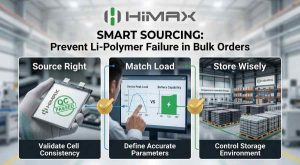
Smart Sourcing Step 1: Match the Battery to the Real Load
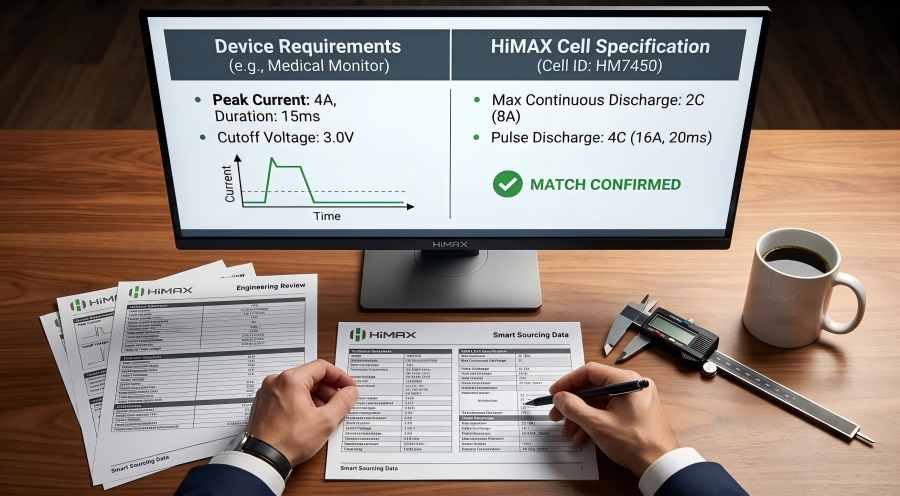
The first smart sourcing step is to understand the real electrical load of the device. Many failures happen because the battery is selected based on average power instead of peak power.
A device may draw only 300mA most of the time. But during startup, wireless transmission, motor activation, or heating, it may draw 2A or more. If the battery is not designed for that peak load, it can heat up and age faster.
Procurement teams should work with engineering teams to confirm:
Average current.
Peak current.
Pulse duration.
Rest time between pulses.
Startup current.
Low-temperature performance needs.
Charging behavior.
Cutoff voltage.
Thermal conditions inside the device.
This information helps the supplier recommend the correct cell structure, tab design, protection circuit, and pack configuration.
Smart Sourcing Step 2: Require Pilot Testing Before Bulk Orders
No enterprise buyer should move directly from quote to mass production without sample validation. Pilot testing helps catch problems early.
A practical pilot test can include:
Capacity test at standard discharge rate.
High current discharge test.
Cycle life test.
Charging and discharging temperature test.
Drop or vibration test for the finished battery pack.
Device runtime test.
Long-term storage test.
Swelling inspection after stress testing.
Connector pull test.
Protection circuit test.
Compatibility test with the final charger.
For large orders, the pilot phase can save the company from major losses. A sample batch of 50 to 200 batteries may reveal issues that are not visible in a single sample.
Smart Sourcing Step 3: Review Cell Consistency and Production Control
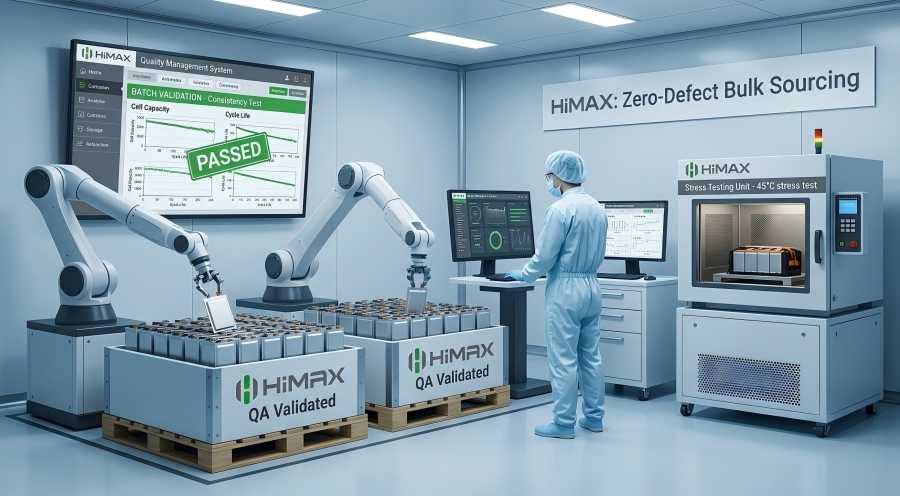
In bulk Li-polymer battery orders, consistency matters. One good sample does not prove that all mass production units will perform the same way.
Enterprise buyers should ask suppliers how they control:
Cell capacity consistency.
Internal resistance consistency.
Voltage matching.
Aging time.
Formation process.
Incoming material inspection.
Pouch sealing quality.
Electrolyte control.
Moisture control.
Pack assembly process.
Final inspection standards.
Batch traceability.
If a supplier cannot explain how production quality is controlled, the buyer should be careful. For enterprise projects, traceability is important. If a failure appears later, the supplier should be able to trace the production batch, materials, inspection records, and testing data.
Smart Sourcing Step 4: Confirm Protection Circuit Design
A Li-polymer battery pack is more than a cell. It often needs a protection circuit that matches the device and charging method.
A proper protection circuit can help prevent:
Overcharge.
Over-discharge.
Overcurrent.
Short circuit.
Excessive temperature.
Cell imbalance in multi-cell packs.
For single-cell Li-polymer batteries, a PCM may be enough for many consumer and industrial devices. For larger packs or more demanding applications, a more advanced BMS may be needed.
Procurement teams should not treat the protection board as a small accessory. It is part of the battery safety system. A weak or poorly matched protection circuit can increase failure risk, even if the cell itself is good.
Case Study 1: Warehouse Barcode Scanner Fleet in Texas
A logistics company in Dallas, Texas operates 2,400 handheld barcode scanners across three distribution centers. Each scanner uses a 3.7V 3200mAh Li-polymer battery pack with a 1.5A average working current and 3A peak current during wireless data sync.
The original battery supplier offered a lower unit price, but the cells were designed for lighter discharge use. After six months, some packs showed swelling because the device had frequent peak load events and long daily charging cycles.
A smarter procurement approach would include a high-drain capable Li-polymer cell, peak current validation at 3A, charger compatibility testing, and a 500-cycle life test at the real duty cycle. For a 2,400-unit fleet, reducing battery failure by even 5% can prevent hundreds of replacements and many hours of device downtime.
Case Study 2: Portable Medical Monitoring Device in California
A medical device company in San Diego, California develops a portable patient monitoring unit. The device uses a 7.4V 5000mAh Li-polymer battery pack. It operates for 8 hours per shift, charges overnight, and must maintain stable performance in clinics, home-care settings, and mobile medical carts.
In this case, procurement cannot choose a battery only by capacity and price. The buyer must confirm cell consistency, protection design, safety documentation, cycle life, charging control, and long-term supply stability.
The company may require 1,000 pilot battery packs before a 20,000-unit annual order. Testing should include runtime validation, thermal testing at 35°C ambient temperature, storage testing at 60% charge, and swelling inspection after repeated charge-discharge cycles.
For medical applications, reliable sourcing protects both the device brand and the end user.
Case Study 3: Smart Home Security Camera in Florida
A smart home brand in Miami, Florida sells a wireless outdoor security camera. The device uses a 3.7V 6000mAh Li-polymer battery. It has low average power consumption, but it experiences current spikes during night vision activation, Wi-Fi transmission, and motion-triggered recording.
Florida’s climate also creates heat and humidity challenges. If the camera housing is exposed to direct sunlight, the internal temperature can become much higher than the outdoor air temperature.
A smart sourcing plan should include thermal testing, peak current testing, enclosure temperature review, and storage guidance. The supplier should recommend a cell that can handle both the electrical load and the expected environment.
For a bulk order of 50,000 battery packs, even a small swelling rate can create a major customer service problem. Procurement should select a supplier that understands outdoor device requirements, not just a supplier with the lowest quote.
Case Study 4: Educational Tablet Program in New York
A school technology distributor in New York supplies 15,000 tablets to public school programs. Each tablet uses a 3.8V 7000mAh Li-polymer battery. The tablets are used by students for 5 to 7 hours per day and are often charged in carts overnight.
This application creates a different risk. The battery may not need very high current, but it must handle repeated daily use, charging management, and long service life. If batteries swell, they can push against the screen, damage the tablet housing, and create large warranty claims.
Procurement should require battery thickness tolerance control, cycle life testing, charger compatibility review, and storage instructions for school breaks. The buyer should also ask for batch traceability because large school deployments need consistent quality across thousands of units.
Storage and Handling Rules for Bulk Li-Polymer Orders
Procurement does not end when the battery order arrives. Storage and handling can also affect battery health.
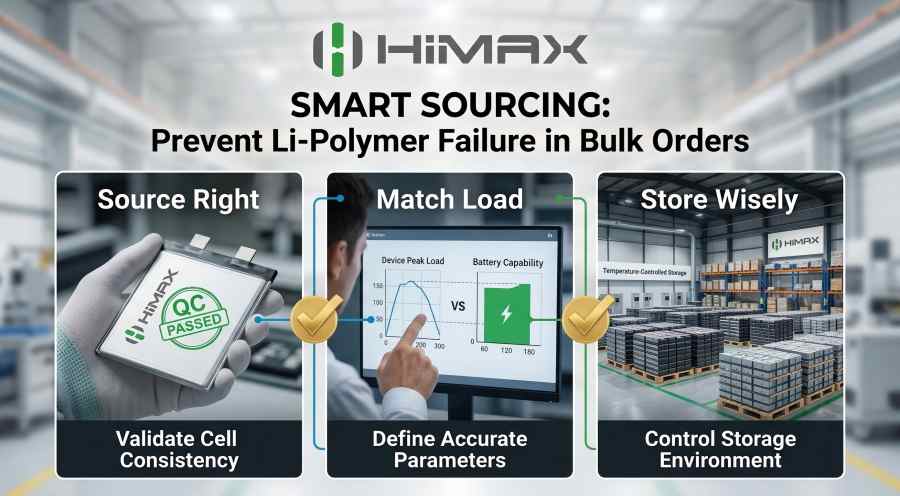
For bulk Li-polymer batteries, companies should avoid high-temperature storage, direct sunlight, heavy stacking pressure, and long-term full-charge storage. Warehouses should follow the supplier’s recommended storage voltage, temperature range, and inspection schedule.
For long-term storage, many Li-polymer batteries are stored at a partial charge rather than full charge. The buyer should confirm the recommended storage voltage with the supplier. They should also plan periodic voltage checks for inventory that remains unused for months.
This is especially important for companies that buy large seasonal inventory. A product may be built months before it reaches the customer. If battery storage is not controlled, performance can decline before the device is even sold.
What to Ask a Li-Polymer Battery Supplier Before Ordering
Enterprise buyers should ask direct questions before placing a bulk order.
- What cell grade will be used?
- What is the real continuous discharge rating?
- What is the peak current rating?
- What is the expected cycle life under our operating conditions?
- What protection circuit is recommended?
- Can the supplier provide test reports?
- Can the supplier support custom dimensions and connectors?
- How does the supplier control cell consistency?
- What certifications are available for the battery pack?
- What is the lead time for samples and mass production?
- How does the supplier handle batch traceability?
- What is the recommended storage voltage and temperature?
- What failure analysis support is available if problems occur?
These questions help procurement teams separate simple battery sellers from real battery manufacturing partners.
Try HiMAX Battery
HiMAX is one of the world’s leading battery manufacturers, providing reliable battery solutions for global businesses across consumer electronics, medical devices, industrial equipment, smart hardware, IoT products, energy storage systems, and custom power applications. With strong engineering support, flexible customization, strict quality control, and experience in lithium polymer batteries, lithium-ion battery packs, LiFePO4 batteries, and other rechargeable battery solutions, HiMAX helps enterprise customers choose the right battery for real-world performance, safety, and long-term value. For companies planning bulk battery orders or custom battery projects, HiMAX offers a trusted manufacturing partner from design review to sample testing and mass production.