Key Takeaways
- Choosing the right battery solution for a water pump is not just about picking the highest capacity battery. The best choice depends on pump voltage, wattage, startup surge, runtime needs, water flow requirements, operating environment, and charging method.
- For residential backup sump pumps, a deep-cycle battery or LiFePO4 battery may provide dependable emergency power during outages.
- For irrigation pumps, solar-compatible lithium battery systems can reduce grid dependence and support off-grid operation.
- For portable transfer pumps, lightweight lithium-ion battery packs may be more convenient than traditional lead-acid batteries.
- The most important rule is simple: match the battery system to the pump’s actual load and working conditions.
Introduce
Water pumps are used in many applications, including home sump systems, farm irrigation, RV water supply, emergency drainage, livestock watering, construction sites, and off-grid cabins. In all of these situations, power reliability matters.
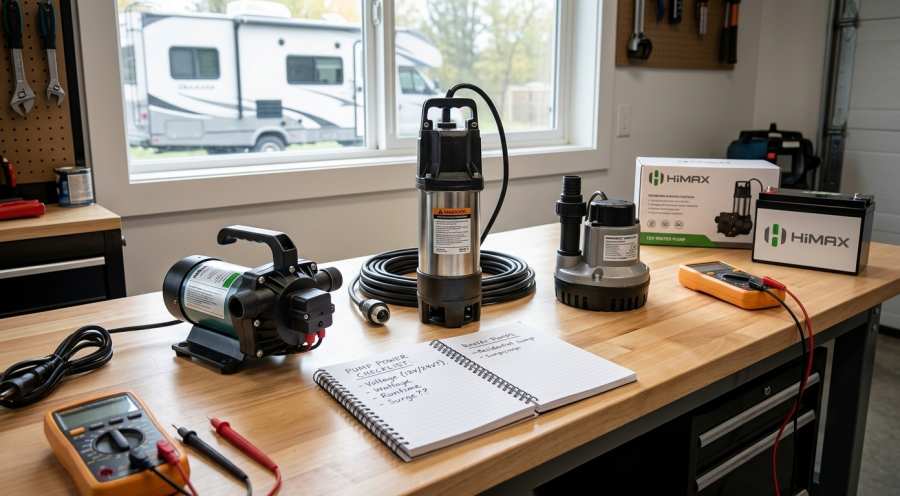
A water pump often needs a steady power supply to move water safely and efficiently. If the battery cannot provide enough current, the pump may fail to start. If the battery capacity is too low, the system may run for only a short time. If the battery chemistry is not suitable for deep discharge, the battery may wear out quickly.
That is why choosing the right battery solution for water pumps requires more than checking the label. You need to understand the pump’s electrical demand, the expected runtime, the installation environment, and the charging source.
Step 1: Identify the Pump Voltage
The first step is to confirm the water pump’s voltage. Common battery-powered water pump systems may use 12V, 24V, 36V, or 48V configurations. Some smaller DC pumps run directly from a 12V battery, while larger irrigation or off-grid systems may require 24V or 48V battery banks.
A 12V system is common for small sump pumps, RV pumps, marine pumps, and portable transfer pumps. A 24V system may be better for medium-duty applications because it can reduce current draw compared with 12V. A 48V system is often used for higher-power solar pump or off-grid water systems.
Matching voltage is essential. A 12V battery should not be connected directly to a 24V pump unless the system is designed with the correct converter or battery configuration. Incorrect voltage can damage the pump, reduce efficiency, or create safety risks.
Step 2: Calculate Power Demand
After voltage, check the pump’s power rating. This may be listed in watts, amps, or horsepower. For battery planning, watts are very useful because they help estimate runtime.
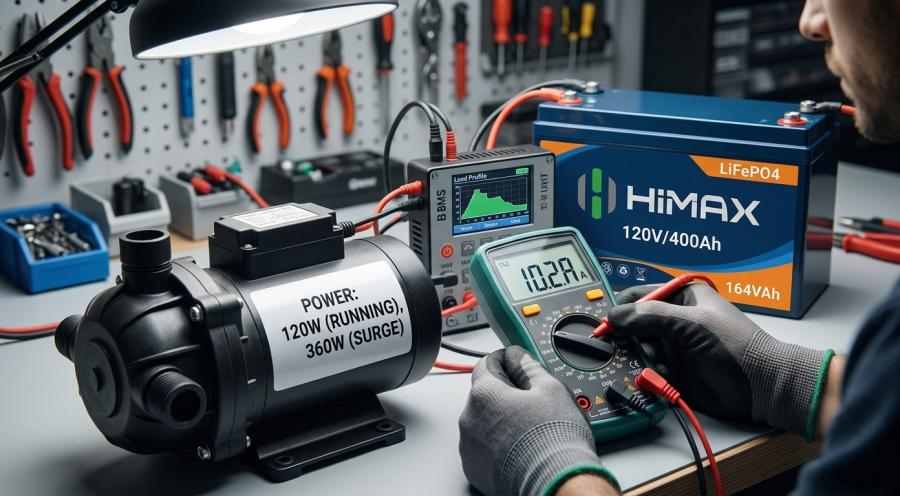
A simple formula is:
Watts = Volts × Amps
For example, if a 12V water pump draws 10 amps during operation, the pump uses about 120 watts. If a 24V pump draws 15 amps, it uses about 360 watts.
However, many pumps require more power at startup than during normal running. This is called startup surge or inrush current. A pump that normally uses 300 watts may briefly require 600–900 watts to start. The battery system, wiring, and inverter must be able to handle this surge.
This is especially important for AC water pumps powered through an inverter. The inverter must have enough continuous power and peak surge capacity to start the pump reliably.
Step 3: Estimate Required Runtime
The next step is to decide how long the pump needs to run. A backup sump pump may only need to run intermittently during a storm. An irrigation pump may need to run for several hours. An RV water pump may run in short bursts throughout the day.
Battery capacity is usually measured in amp-hours or watt-hours. Watt-hours are easier for comparing systems because they account for voltage.
A basic formula is:
Watt-hours = Battery Voltage × Amp-hours
For example, a 12V 100Ah battery stores about 1,200 watt-hours of energy. If a pump uses 300 watts, the theoretical runtime is about 4 hours. In real use, runtime may be lower because of inverter losses, battery discharge limits, temperature, and pump cycling behavior.
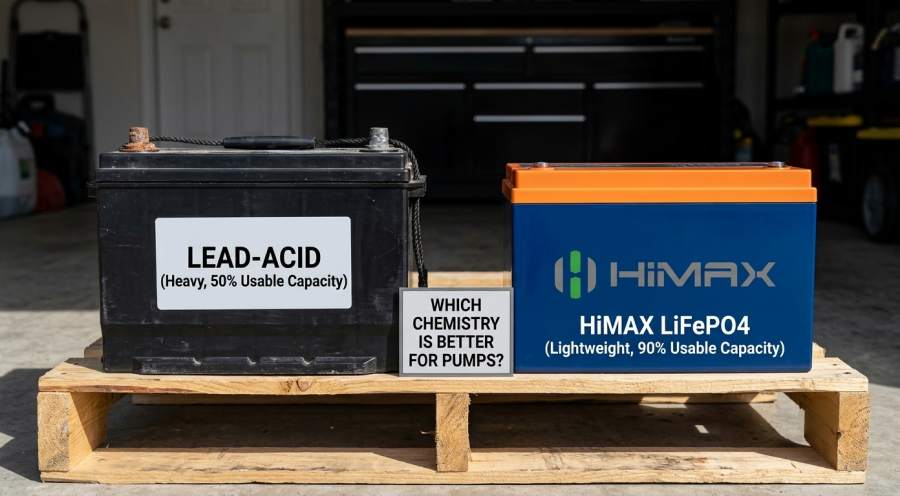
For lead-acid batteries, it is often better not to discharge below 50% if you want longer battery life. For LiFePO4 batteries, usable capacity is typically much higher, often around 80–90% depending on the battery management system and manufacturer recommendations.
Step 4: Choose the Right Battery Chemistry
Lead-Acid Batteries
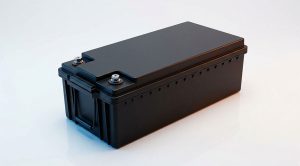
Lead-acid batteries are widely available and often cost less upfront. Deep-cycle AGM or gel batteries are commonly used for sump pump backup systems and basic off-grid applications.
The advantages are lower initial cost, broad availability, and familiar technology. The disadvantages are heavier weight, shorter cycle life, slower charging, and lower usable capacity compared with lithium options.
Lead-acid can be a reasonable choice for occasional backup use, especially where budget is the main concern.
Lithium-Ion Batteries
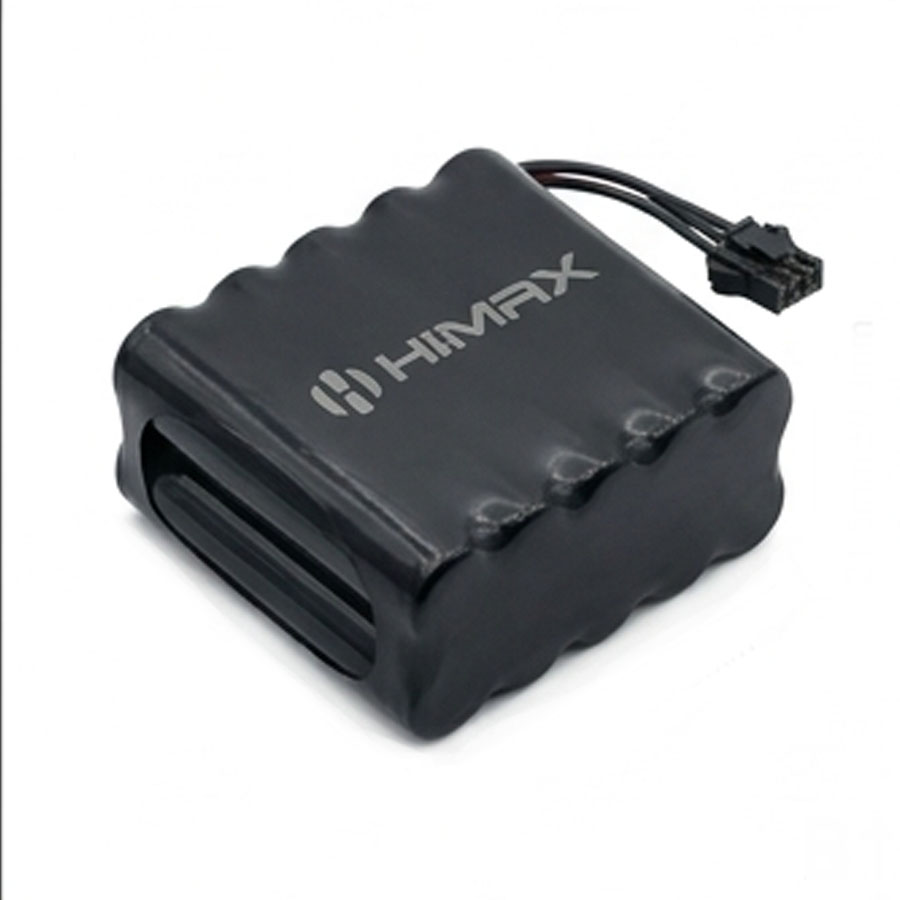
Lithium-ion batteries offer higher energy density, lighter weight, and better efficiency than traditional lead-acid batteries. They are useful for portable water pump systems, compact power packs, and applications where space and weight matter.
However, lithium-ion systems should be selected carefully with the right protection circuit, charging method, and environmental rating.
LiFePO4 Batteries
LiFePO4, or lithium iron phosphate, is one of the strongest options for many water pump battery systems. It offers long cycle life, stable performance, high usable capacity, and strong safety characteristics compared with many other lithium chemistries.
For solar water pumps, off-grid systems, irrigation backup, and long-term cycling applications, LiFePO4 can be a smart investment. Although the upfront cost is usually higher than lead-acid, the longer lifespan and deeper usable capacity may reduce long-term cost.
Step 5: Consider the Charging Method
A battery solution is only useful if it can be recharged properly. Water pump battery systems may be charged by grid power, solar panels, vehicle alternators, generators, or hybrid charging setups.
For home sump pump backup, the battery is usually connected to an AC charger that keeps it ready during normal conditions. For farms and remote sites, solar charging may be more practical. For RV and marine systems, charging may come from shore power, solar, or the vehicle alternator.
If using solar, the system should include a properly sized charge controller. The solar panel output should match the battery size and daily energy demand. For example, a pump used every day for irrigation will need a larger solar array than a battery used only for emergency backup.
Step 6: Check the Operating Environment
Water pump batteries may be exposed to moisture, heat, cold, dust, vibration, or outdoor conditions. The battery solution should be designed for the environment where it will operate.
For outdoor pump systems, consider weather-resistant enclosures, proper ventilation, protected wiring, and safe mounting. For cold climates, battery performance can drop significantly, especially with lead-acid batteries. Some lithium batteries include low-temperature protection or heating functions.
For agricultural, construction, or emergency drainage applications, durability is especially important. A battery that works well in a clean indoor environment may not be suitable for muddy, wet, or high-vibration field conditions.
Step 7: Match the Battery to the Pump Application
Different water pump applications require different battery priorities.
A backup sump pump needs reliability, standby readiness, and enough runtime during storms. A solar irrigation pump needs daily cycling ability, solar charging compatibility, and long cycle life. A portable transfer pump needs lightweight design, fast charging, and easy transport. A livestock watering system needs stable off-grid operation and dependable performance in outdoor conditions.
There is no single battery that is perfect for every water pump. The right battery solution depends on the job.
Explore Scenarios
Scenario 1: Residential Backup Sump Pump in Ohio
A homeowner in Columbus, Ohio has a 12V backup sump pump rated at 10 amps. The pump uses about 120 watts while running. During heavy rain, it may cycle on for 5 minutes every 20 minutes.
If the homeowner wants protection during a 10-hour power outage, the pump may run for about 150 minutes total, or 2.5 hours. At 120 watts, that requires about 300 watt-hours of usable energy. A 12V 50Ah LiFePO4 battery provides about 600 watt-hours of total energy, giving a practical safety margin.
For this case, a 12V LiFePO4 battery with a compatible charger can be a strong choice because it offers reliable usable capacity, long standby life, and lower maintenance than flooded lead-acid batteries.
Scenario 2: Small Farm Irrigation Pump in California
A small grower in Fresno, California uses a 24V DC water pump for drip irrigation. The pump draws 15 amps during operation, meaning it uses about 360 watts. The grower wants to run the pump for 3 hours per day.
Daily energy demand is about 1,080 watt-hours. A 24V 100Ah LiFePO4 battery stores about 2,400 watt-hours, which provides enough usable energy for daily operation with reserve capacity. A properly sized solar panel array and MPPT charge controller can help recharge the system during the day.
For this application, LiFePO4 is better than lead-acid because the system cycles regularly. Longer cycle life and deeper usable capacity make a big difference over time.
Scenario 3: RV Water Pump for Weekend Camping in Colorado
An RV owner in Colorado uses a 12V water pump that draws 7 amps when running. The pump is used in short bursts for the sink, shower, and toilet. Total daily pump runtime may be only 30 minutes.
The pump uses about 84 watts. For 30 minutes per day, energy use is about 42 watt-hours. Even over a three-day weekend, the pump itself may use only around 126 watt-hours. However, the RV battery may also power lights, fans, USB charging, and a refrigerator controller.
For this case, a 12V lithium battery system is convenient because it is lighter, charges efficiently, and provides stable voltage for multiple RV loads.
Scenario 4: Emergency Flood Pump for a Construction Site in Florida
A construction crew in Tampa, Florida needs a portable pump to remove standing water after storms. The pump runs through an inverter and requires 700 watts continuous power with a 1,500-watt startup surge.
In this case, the battery solution must support both capacity and high discharge current. A small battery may have enough watt-hours on paper but fail during pump startup. The system needs a battery with a suitable battery management system, heavy-duty wiring, and an inverter rated for the surge load.
A rugged lithium battery pack or LiFePO4 battery bank with a high-output inverter would be more appropriate than a small consumer power pack.
Scenario 5: Remote Livestock Watering System in Texas
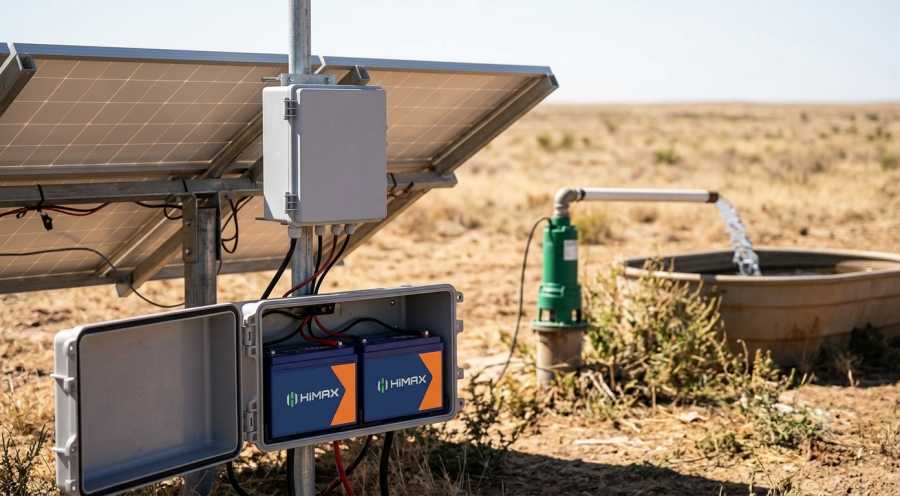
A rancher in West Texas needs a pump system to move water to a livestock trough. The site has no grid power, but it receives strong sunlight. The pump runs for 1.5 hours per day and uses 250 watts.
Daily energy demand is about 375 watt-hours. A solar-charged 12V or 24V LiFePO4 battery system can provide stable off-grid power. The battery should be housed in a protective enclosure, with proper temperature protection and enough reserve capacity for cloudy days.
For livestock watering, reliability matters more than the lowest upfront cost. A failed pump can quickly create animal welfare and operational problems.
Common Mistakes to Avoid
- One common mistake is choosing a battery based only on amp-hours without checking voltage. A 100Ah battery at 12V does not store the same energy as a 100Ah battery at 24V.
- Another mistake is ignoring startup surge. Pumps are motor-driven devices, and motors often need extra power when starting. If the battery or inverter cannot handle that surge, the system may shut down.
- A third mistake is using a starter battery instead of a deep-cycle battery. Car starter batteries are designed to provide short bursts of high current, not long repeated discharges. For water pump applications, a deep-cycle battery is usually the better choice.
- Finally, some users forget about environmental protection. Batteries should be installed safely, kept away from direct water exposure, and matched with the right charger and wiring.
Custom Water Pump Battery Solutions at HiMAX
HiMAX is one of the world’s leading battery manufacturers, providing reliable battery solutions for industrial, commercial, and everyday power applications. With experience in lithium-ion, LiFePO4, and custom battery pack design, HiMAX helps customers build power systems that match real-world performance requirements.
For water pump applications, HiMAX can support customized battery solutions based on voltage, capacity, discharge current, cycle life, size, charging method, and working environment. Whether you need a compact battery pack for a portable pump, a long-cycle LiFePO4 solution for solar irrigation, or a high-reliability backup power system, HiMAX batteries are designed to deliver stable performance and dependable energy.
Choose HiMAX for efficient, durable, and application-ready battery solutions built for modern water pump systems.
Find articles related to LiFePO4 Battery