Key Takeaways
- Choosing the right battery solution for an electric boat starts with understanding how the boat will actually be used: cruising speed, trip distance, passenger load, motor power, charging access, and safety requirements.
- For most modern electric boats, lithium battery solutions—especially LiFePO4 marine battery packs—offer a strong balance of usable capacity, long cycle life, stable performance, and lower weight compared with traditional lead-acid options.
- The right electric boat battery should not only match the motor’s voltage and power demand, but also provide enough usable energy in kilowatt-hours, proper Battery Management System protection, marine-grade installation safety, and reliable charging support.
Why the Battery Matters in an Electric Boat
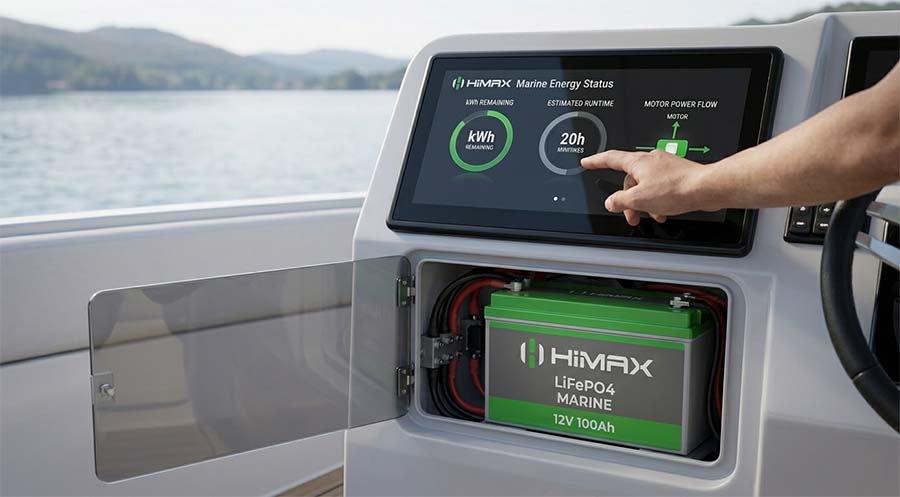
An electric boat is only as capable as its battery system. The motor determines how much power the boat can produce, but the battery determines how long that power can be delivered. A well-matched battery solution helps improve cruising range, acceleration, safety, weight balance, charging efficiency, and overall ownership cost.
Unlike a simple trolling motor battery or a small house battery, an electric boat battery system often needs to support propulsion, navigation electronics, lighting, pumps, communication devices, and sometimes onboard appliances. That means choosing a battery is not just about voltage or amp-hours. It is about designing a complete marine energy system.
For electric propulsion, battery capacity is usually measured in kilowatt-hours, or kWh. A higher kWh rating generally means longer runtime, but actual range depends on hull type, boat weight, water conditions, speed, motor efficiency, and passenger load. This is why two boats using the same battery pack may deliver very different real-world performance.
Step 1: Define How You Use the Electric Boat
Before choosing a battery, start with your boating scenario. A fishing boat, pontoon boat, electric sailboat, harbor cruiser, and small workboat all have different energy demands.
Ask these questions first:
- How many hours do you want to operate per trip?
- What is your normal cruising speed?
- What is the maximum motor power in kW?
- Do you need high-speed bursts or steady low-speed cruising?
- How many passengers or how much cargo will the boat carry?
- Will you charge at a marina, home dock, solar system, or portable charger?
- Do you need a battery for propulsion only, or propulsion plus house loads?
For example, a boat used for two-hour lake cruising on weekends may need a very different battery solution than a commercial electric workboat operating six hours per day.
Step 2: Match Battery Voltage to the Motor System
Electric boat motors are commonly designed around specific voltage platforms, such as 24V, 36V, 48V, 72V, or higher-voltage systems. The battery must match the motor controller’s voltage requirement.
For smaller boats, 24V or 48V systems are common. For larger electric propulsion systems, higher-voltage battery packs may be more efficient because they can reduce current draw for the same power output. Lower current can help reduce heat, cable size, and electrical losses, but higher-voltage systems also require more careful design and safety protection.
A simple way to think about it:
Power = Voltage × Current
A 10 kW motor at 48V requires much higher current than a 10 kW motor at 96V. That is why matching system voltage is one of the first steps in battery selection.
Step 3: Calculate Required Battery Capacity
Battery capacity for an electric boat should be estimated based on power consumption and desired runtime.
Basic formula:
Required battery capacity = Average power draw × Runtime
For example, if your boat typically uses 5 kW while cruising and you want 3 hours of runtime:
5 kW × 3 hours = 15 kWh
However, you should not size the battery with zero reserve. Marine applications need a safety margin for wind, current, emergency return, battery aging, and unexpected route changes. A practical reserve is often 15%–30%, depending on usage.
So in this example, a 15 kWh requirement may become:
15 kWh × 1.25 reserve factor = 18.75 kWh
That means a battery solution around 19–20 kWh may be more realistic.
Step 4: Choose the Right Battery Chemistry
The most common battery choices for electric boats include lead-acid, AGM, lithium-ion, and LiFePO4. For modern electric boats, LiFePO4 is often preferred because it offers a strong combination of safety, cycle life, usable capacity, and weight savings.
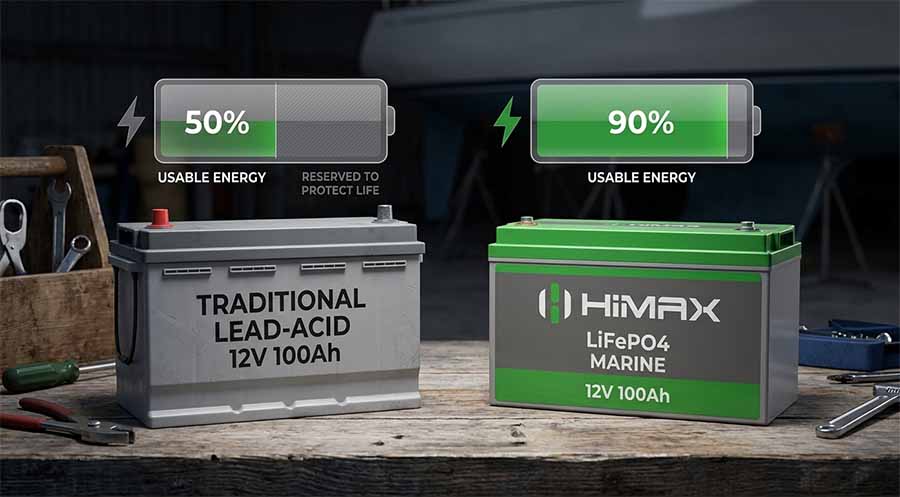
Lead-acid batteries may cost less upfront, but they are heavy and usually provide less usable energy. In many applications, only about half of a lead-acid battery’s rated capacity is practically usable if you want to protect battery life. Lithium batteries, by contrast, typically allow deeper usable discharge and better energy density.
LiFePO4 batteries are especially attractive for marine applications because they are known for thermal stability, long service life, and consistent voltage output. For electric boats, that can mean more predictable range and better long-term value.
Lithium marine battery installations should be designed carefully. The ABYC E-13 standard addresses the selection and installation of lithium-ion batteries on boats, including lithium battery system design for house banks, cranking, and propulsion systems, and applies to installed boat battery systems over 500 Wh. (ANSI Webstore)
Step 5: Pay Attention to the Battery Management System
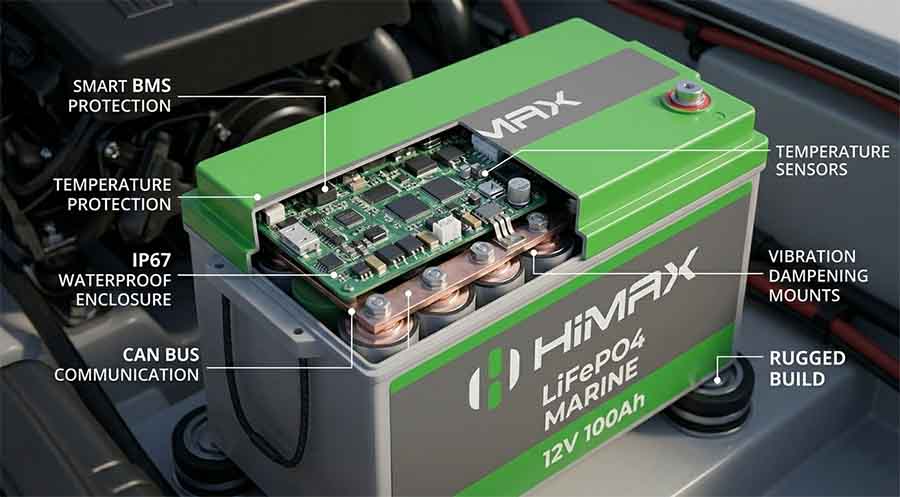
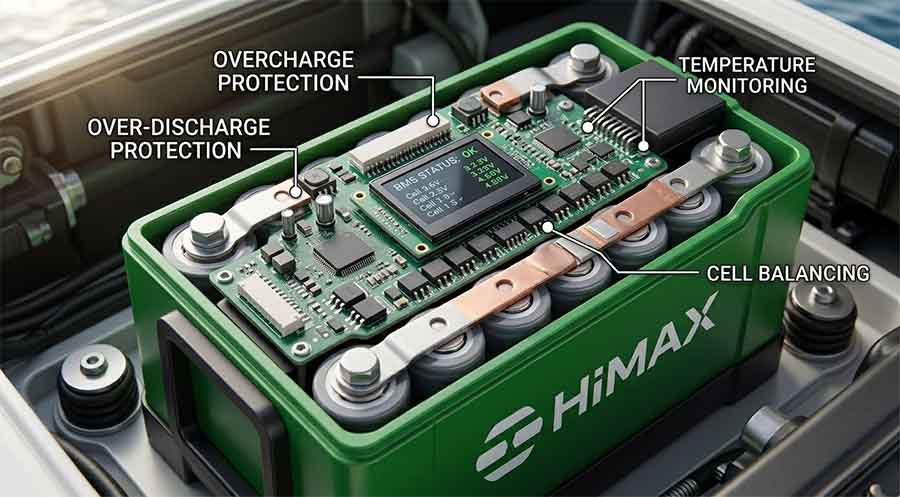
A high-quality Battery Management System, or BMS, is essential for an electric boat battery. The BMS helps protect the battery from unsafe operating conditions and supports long-term reliability.
Important BMS protections include:
- Overcharge protection
- Over-discharge protection
- Over-current protection
- Short-circuit protection
- Temperature monitoring
- Cell balancing
- Communication with chargers or controllers
- Fault alerts and shutdown protection
For marine use, the BMS should be designed for real-world conditions such as vibration, humidity, salt air, high current demand, and temperature changes. A battery pack without a reliable BMS is not suitable for serious electric propulsion use.
Step 6: Consider Weight and Space
Weight is one of the biggest advantages of lithium battery systems for electric boats. A lighter battery pack can improve efficiency, increase range, reduce draft, and make the boat easier to handle.
However, battery placement matters. The battery should be installed in a secure, balanced location that supports the boat’s center of gravity. Poor battery placement can affect trim, stability, and handling.
For small boats, saving 100–300 pounds can noticeably improve performance. For larger boats, the weight savings can be even more important because it may allow more passenger capacity, cargo space, or additional onboard systems.
Step 7: Check Charging Requirements
The right battery solution also needs the right charging system. Charging time depends on battery capacity, charger output, shore power availability, and the battery’s recommended charge rate.
For example:
Battery capacity: 20 kWh
Charger power: 5 kW
Estimated ideal charge time: 20 ÷ 5 = 4 hours
In real-world use, charging may take longer due to efficiency losses and charge tapering. If the boat is used commercially, charging speed becomes especially important. A rental fleet, ferry, or workboat may need opportunity charging between trips, while a weekend lake boat may only need overnight charging.
The U.S. Department of Energy explains that battery-electric vehicles use a traction battery pack to power an electric motor and must be plugged into charging equipment; the same basic energy logic applies when designing an electric propulsion battery and charging system for boats. (Alternative Fuels Data Center)
Step 8: Choose Marine-Grade Safety and Installation Design
An electric boat battery solution must be designed for a marine environment. That means more than simply placing a battery inside a boat.
Look for:
- Marine-grade enclosure design
- Proper mounting against vibration and movement
- Waterproof or water-resistant protection where appropriate
- Corrosion-resistant connectors
- Correct cable sizing
- Proper fusing and over-current protection
- Ventilation and heat management
- Clear emergency disconnect access
- Compatibility with marine chargers and controllers
ABYC E-13 is focused on safer lithium battery installations on boats, and industry discussions around the standard emphasize installation, system design, and manufacturer safety information rather than treating the battery as a simple drop-in component. (ANSI Webstore)
Application Case
Case 1: Weekend Electric Pontoon Boat on a Lake
A family in Austin, Texas uses a 22-foot electric pontoon boat for weekend cruising. The boat carries 4–6 passengers and usually cruises at low to medium speed.
Example parameters:
Boat type: 22-foot pontoon
Motor power: 10 kW
Average cruising draw: 4–6 kW
Desired runtime: 3 hours
Estimated energy need: 12–18 kWh
Recommended reserve: 20%
Suggested battery solution: 48V or 72V LiFePO4 marine battery system, around 18–22 kWh
Why this works:
A pontoon boat is often used for relaxed cruising rather than high-speed operation. A LiFePO4 battery pack provides enough usable energy for several hours on the water while reducing weight compared with a large lead-acid battery bank. The owner should prioritize range, safety, and easy marina or home-dock charging.
Case 2: Electric Fishing Boat for Quiet Morning Trips
A fishing customer in Minnesota uses a 17-foot aluminum fishing boat for early morning lake fishing. The boat needs quiet propulsion, stable power, and enough range to move between fishing spots.
Example parameters:
Boat type: 17-foot aluminum fishing boat
Motor power: 5 kW
Average cruising draw: 2–3 kW
Electronics load: fish finder, lights, GPS, livewell pump
Desired runtime: 4 hours
Estimated propulsion energy: 8–12 kWh
House load allowance: 0.5–1.5 kWh
Suggested battery solution: 48V LiFePO4 battery system, around 12–15 kWh
Why this works:
Fishing boats often operate at lower speeds with intermittent movement. The battery should support both propulsion and electronics without voltage drop. A properly sized LiFePO4 battery system can provide quiet operation, stable output, and enough reserve to return safely to the dock.
Case 3: Small Electric Harbor Cruiser in California
A boat owner in Newport Beach, California uses a compact electric cruiser for short harbor trips and sunset rides.
Example parameters:
Boat type: 18–20-foot harbor cruiser
Motor power: 15 kW
Average cruising draw: 6–8 kW
Desired runtime: 2.5 hours
Estimated energy need: 15–20 kWh
Recommended reserve: 25%
Suggested battery solution: 72V or 96V lithium marine battery system, around 22–25 kWh
Why this works:
Harbor cruising may involve slow-speed operation, but wind, current, and passenger load can increase energy use. A higher-voltage system may help support stronger propulsion performance while keeping current more manageable. The battery solution should be compact, safe, and optimized for regular charging at a dock.
Case 4: Commercial Electric Workboat
A marina service company in Florida operates a small electric workboat for inspections, light towing, and dock maintenance.
Example parameters:
Boat type: 20-foot workboat
Motor power: 20 kW
Average working draw: 8–12 kW
Daily operation: 5 hours
Estimated energy need: 40–60 kWh
Charging window: overnight plus mid-day top-up
Suggested battery solution: Custom high-capacity LiFePO4 marine battery pack, 48–60 kWh, with advanced BMS communication
Why this works:
Commercial users need durability, predictable runtime, fast serviceability, and strong safety design. For this type of boat, the battery should be engineered as a complete system, not selected only by amp-hour rating. Cycle life, thermal management, charger compatibility, and maintenance access are all critical.
Mistakes When Choosing an Electric Boat Battery
One common mistake is choosing a battery based only on amp-hours. Amp-hours are only meaningful when paired with voltage. A 100Ah battery at 12V stores much less energy than a 100Ah battery at 48V.
Another mistake is ignoring reserve capacity. Boats face changing wind, current, waves, and load conditions. A battery that looks sufficient on paper may feel inadequate in real water conditions.
A third mistake is using non-marine battery packs in a marine environment. Electric boat batteries should be designed for vibration, humidity, corrosion risk, and safe installation.
Finally, some buyers underestimate charging needs. A large battery pack with a small charger may work for overnight use, but it may not be practical for frequent daily operation.
What to Look for in a Reliable Electric Boat Battery Supplier
When comparing battery suppliers, look beyond the price per kWh. A strong supplier should help with system-level design, not just sell a battery box.
Important supplier capabilities include:
- Custom voltage and capacity options
- Marine-grade battery pack design
- Reliable LiFePO4 cell selection
- Smart BMS integration
- Charger compatibility support
- Engineering support for OEM projects
- Safety documentation
- Long-term production consistency
- Support for custom enclosures and communication protocols
For electric boat builders, distributors, and fleet operators, customization may be necessary. The best battery solution should match the boat’s propulsion system, available space, operating profile, and charging infrastructure.
Custom Electric Boat Battery Solutions at HiMAX
HiMAX is one of the world’s leading battery manufacturers, providing advanced lithium battery solutions for demanding applications, including electric boats, marine energy storage, industrial equipment, robotics, medical devices, mobility systems, and custom OEM projects. With strong engineering capabilities, reliable production quality, and flexible customization support, HiMAX helps customers design battery packs that match real-world performance requirements. From LiFePO4 marine battery packs to high-capacity custom lithium battery systems, HiMAX delivers dependable power solutions built for safety, efficiency, and long-term value.
Find articles related to LiFePO4 Battery