Key Takeaways
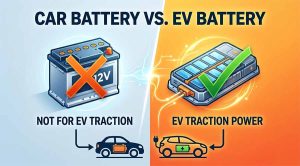
- A traditional car battery and an EV battery are not interchangeable because they serve completely different electrical jobs.
- Most gas-powered vehicles use a 12-volt battery mainly for starting the engine and powering low-voltage electronics.
- Electric vehicles use a high-voltage traction battery to drive the motor, while many EVs also have a separate low-voltage auxiliary battery for accessories and vehicle startup systems.
- Swapping the wrong battery type can damage electronics, trigger safety faults, void warranties, or create serious electrical hazards.
- The safest replacement strategy is to match the vehicle manufacturer’s voltage, chemistry, size, terminal layout, cold cranking amps, reserve capacity, and battery management requirements.
- For EV traction battery work, always use certified technicians and approved replacement packs or modules.
Introduction: Why This Question Matters More Than Ever
As electric vehicles become more common in American driveways, many drivers are asking a practical question: Car battery vs. EV battery — can you swap them without damaging your vehicle?
The short answer is no, not in the way most people think.
A regular car battery, usually a 12V lead-acid or AGM battery, is designed to start an internal combustion engine and support low-voltage electrical systems. An EV battery, on the other hand, usually refers to a high-voltage lithium-ion traction battery that powers the electric motor. The U.S. Alternative Fuels Data Center notes that all-electric, plug-in hybrid, and hybrid vehicles typically use high-voltage systems ranging from 400 to 1,000 volts.
That voltage difference alone makes casual swapping unsafe and technically impossible. But the issue goes deeper than voltage. Battery chemistry, battery management systems, cooling design, software communication, charging profiles, mounting structure, and safety protections all determine whether a battery can work safely in a vehicle.
This guide explains the real difference between a car battery and an EV battery, when replacement is safe, when it is dangerous, and how drivers, repair shops, fleet managers, and battery buyers can choose the right solution.
What Is a Traditional Car Battery?
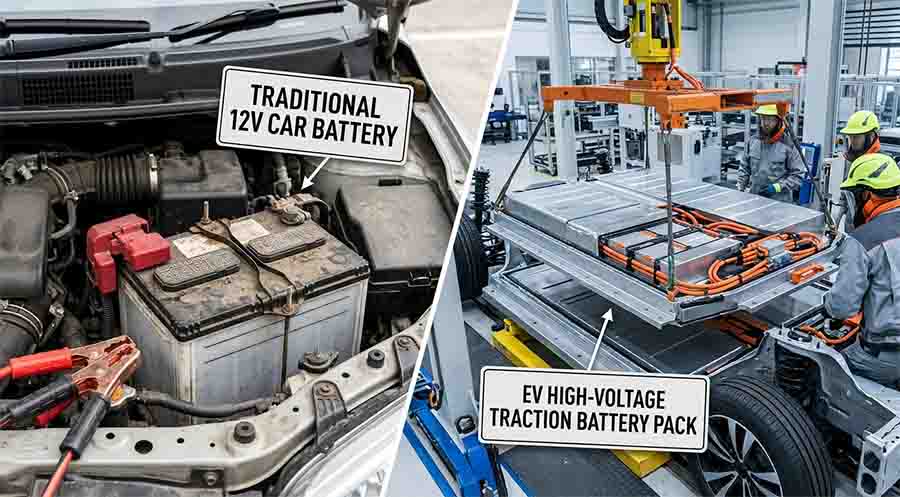
When most U.S. drivers say “car battery,” they usually mean the 12V battery under the hood or in the trunk of a gasoline or diesel vehicle.
Its main jobs include:
- Starting the engine
- Powering headlights, locks, infotainment, sensors, and control modules
- Stabilizing voltage while the alternator is operating
- Supporting emergency electrical functions when the engine is off
Traditional 12V batteries are commonly lead-acid, AGM, EFB, or in some newer applications lithium-based auxiliary batteries. For gas-powered vehicles, one of the most important ratings is cold cranking amps, often called CCA. AAA describes CCA as an industry standard for rating battery starting performance, especially when a vehicle needs power to crank the engine.
In simple terms, a traditional car battery is a high-current, low-voltage starting and accessory battery.
It is not designed to drive a vehicle down the road.
What Is an EV Battery?
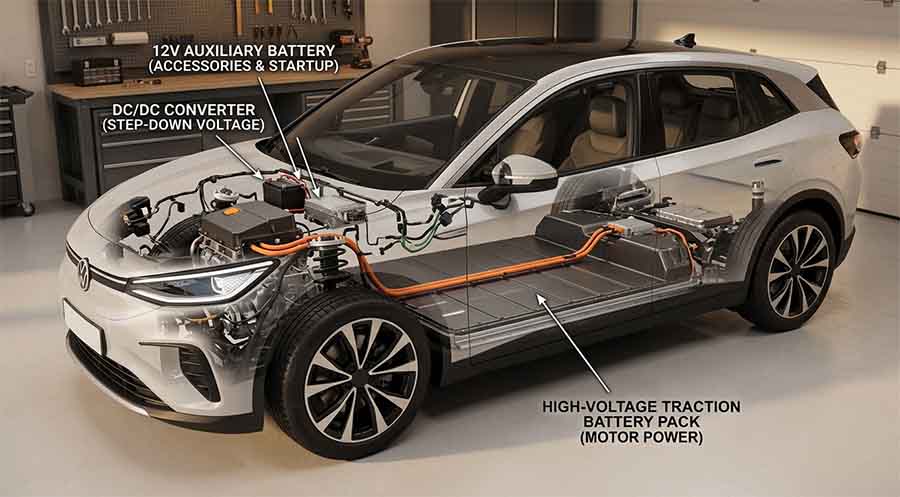
An EV battery usually means the high-voltage traction battery pack that powers the electric motor. This is the main energy storage system in a battery electric vehicle.
Unlike a 12V car battery, an EV traction battery must handle:
- High voltage output
- High energy capacity, often measured in kWh
- Thermal management
- Fast charging
- Regenerative braking input
- Battery management system communication
- Cell balancing and safety monitoring
The Alternative Fuels Data Center explains that an all-electric vehicle also includes a DC/DC converter, which converts high-voltage DC power from the traction battery into lower-voltage power for accessories and to recharge the auxiliary battery.
This is important because many EVs still use a separate low-voltage auxiliary battery. That smaller battery is not the same as the high-voltage EV battery. It may wake up vehicle computers, power accessories, support door locks, and help initialize the main traction system.
So when someone asks, “Can I replace an EV battery with a car battery?” the first question should be:
Are we talking about the EV’s low-voltage auxiliary battery or the EV’s high-voltage traction battery?
The answer changes completely.
Car Battery vs. EV Battery: Key Differences
| Feature | Traditional Car Battery | EV Low-Voltage Auxiliary Battery | EV High-Voltage Traction Battery |
| Typical Voltage | 12V | Usually 12V, sometimes other low-voltage systems depending on vehicle design | Often hundreds of volts |
| Main Function | Starts engine and powers accessories | Powers accessories, control modules, and startup systems | Powers electric drive motor |
| Common Chemistry | Flooded lead-acid, AGM, EFB | AGM, lead-acid, or lithium auxiliary battery | Lithium-ion battery pack |
| Capacity Rating | Ah, CCA, reserve capacity | Ah, reserve capacity, OEM-specific requirements | kWh energy capacity |
| Charging Source | Alternator | DC/DC converter from traction battery | EV charger and regenerative braking |
| Replacement Complexity | Moderate DIY or shop service | Vehicle-specific, sometimes DIY, sometimes shop service | Certified EV technician only |
| Swap Risk | Wrong size or CCA can cause starting issues | Wrong type can trigger electrical faults | Wrong pack can cause severe damage or safety hazards |
| Safe to Swap with EV Traction Battery? | No | No | No |
Industry Solution: Match the Battery to the Vehicle System
From an industry solutions perspective, the correct approach is not “Can I make this battery fit?” but rather “What electrical role does this battery need to perform?”
For battery manufacturers, distributors, repair shops, and fleet operators, the safe selection process should include:
- Identify the battery role
Is it for engine starting, low-voltage EV support, deep-cycle accessory use, or high-voltage traction? - Confirm voltage and chemistry
A 12V lead-acid battery, 12V AGM battery, 12V lithium auxiliary battery, and 400V+ EV pack are not functionally interchangeable. - Match physical specifications
Group size, mounting points, terminal position, venting, cable clearance, and vibration resistance must match the vehicle. - Match performance requirements
For gas vehicles, CCA and reserve capacity matter. For EV auxiliary batteries, stable low-voltage support and compatibility matter. For traction batteries, kWh capacity, cooling, BMS communication, and pack architecture matter. - Follow OEM service procedures
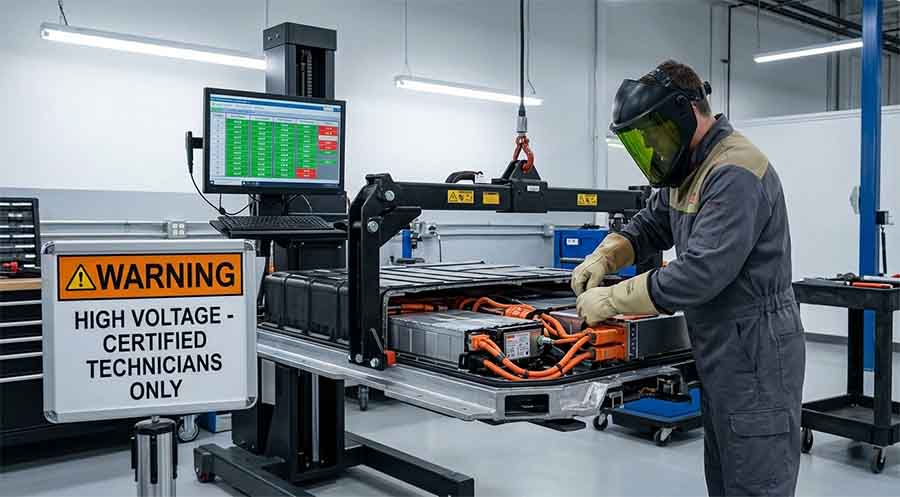
Some vehicles require battery registration, coding, or system reset after replacement. - Use certified service for high-voltage systems
EV traction battery replacement should not be treated like a standard 12V battery swap.
Driver Scenarios: What Works and What Does Not
Scenario 1: Michigan Winter Gas SUV
A driver in Grand Rapids owns a 2018 gasoline SUV with a 3.6L engine. The vehicle originally requires a 12V AGM battery with about 760 CCA and a group size that fits the factory tray.
In January, morning temperatures drop to 5°F. The engine cranks slowly, the headlights dim at idle, and the battery tests below the manufacturer’s CCA requirement.
Correct solution: Replace it with a 12V AGM battery that meets or exceeds the OEM CCA rating, reserve capacity, size, and terminal layout.
Wrong solution: Install an EV lithium traction module or a random lower-CCA battery. The vehicle needs high cranking current, not high-voltage propulsion energy.
AAA notes that cold weather performance is one reason drivers should choose a battery that meets or exceeds manufacturer specifications.
Scenario 2: California EV With a Dead Auxiliary Battery
A San Diego driver owns a 2022 electric crossover with a 75 kWh traction battery. The main battery has 68% state of charge, but the car will not fully wake up. The app does not connect, the doors unlock slowly, and the dashboard shows low-voltage warnings.
This may not be a failed high-voltage battery. It may be the low-voltage auxiliary battery.
Correct solution: Test the auxiliary battery and replace it with the correct OEM-compatible low-voltage battery if needed. Confirm whether the vehicle requires software reset or battery registration.
Wrong solution: Assume the 75 kWh traction pack is dead or attempt to install a conventional gas-car battery that does not match the EV’s auxiliary battery requirements.
EVs can depend on low-voltage auxiliary batteries to power accessories and startup systems, while the DC/DC converter supports low-voltage power from the traction system.
Scenario 3: Texas Small Business Fleet
A delivery company in Dallas operates 12 gasoline vans and 6 electric delivery vans. Summer temperatures often reach 100°F. The gas vans use 12V batteries with high CCA and reserve capacity. The electric vans use high-voltage traction batteries plus low-voltage auxiliary batteries.
The fleet manager wants to simplify inventory and use one battery type across all vehicles.
Correct solution: Standardize by category, not by one universal battery. Keep separate approved battery SKUs for gasoline starter batteries, EV auxiliary batteries, and any OEM-approved EV traction battery service parts.
Wrong solution: Use the same 12V battery across every vehicle without checking chemistry, battery monitoring requirements, mounting, venting, and OEM specifications.
A mixed fleet needs a battery management strategy, not a one-size-fits-all shortcut.
Scenario 4: DIY Camper Conversion
A user in Colorado is building a weekend camper setup and wants to power a fridge, lights, fan, and inverter. The estimated load is 600 watt-hours per night.
Correct solution: Use a properly sized deep-cycle battery or lithium energy storage system designed for auxiliary power, with the right charger, fuse protection, and battery management system.
Wrong solution: Repurpose EV traction battery modules without professional design. EV modules can be dangerous if not managed correctly, especially without proper BMS, enclosure, fusing, and thermal protection.
What Happens If You Use the Wrong Battery?
Using the wrong battery can create both short-term and long-term problems.
A low-CCA battery in a gas vehicle may work in warm weather but fail during winter starts. A flooded lead-acid battery installed where an AGM battery is required may not charge correctly or may fail early. A battery with reversed terminals can damage electronics immediately. A non-compatible EV auxiliary battery may trigger warning lights, communication faults, or startup failure.
For EV traction batteries, the risk is much higher. The pack is not just a battery. It is a complete energy system tied to software, cooling, sensors, crash protection, charging behavior, and vehicle control logic.
That is why the safest rule is simple:
Replace the same battery function with the same approved battery class. Do not cross-swap between starter batteries, auxiliary batteries, and EV traction batteries.
Battery Replacement Checklist
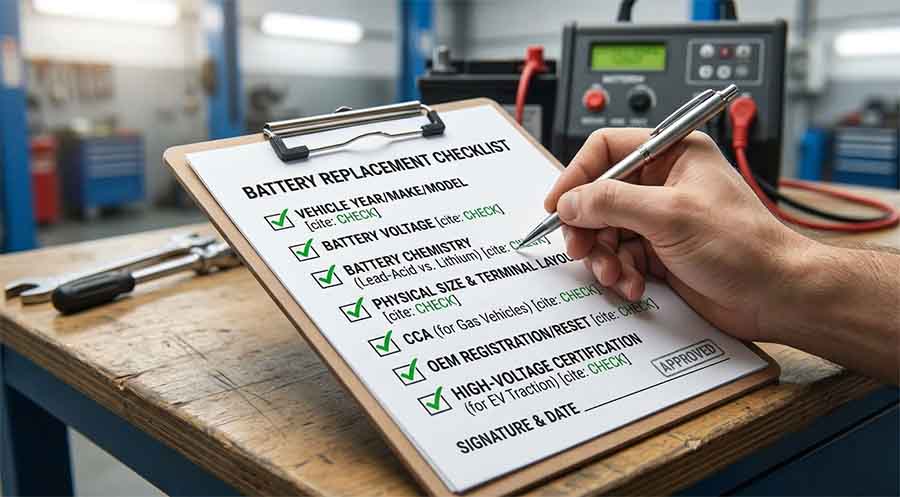
Before replacing any vehicle battery, check the following:
- Vehicle year, make, model, and trim
- Battery voltage
- Battery chemistry
- Group size or physical dimensions
- Terminal layout and polarity
- CCA requirement for gas vehicles
- Reserve capacity or Ah rating
- Venting requirements
- Battery monitoring sensor compatibility
- OEM registration or reset procedure
- Warranty requirements
- High-voltage certification needs for EV traction systems
Explore HiMAX’s battery solutions.
HiMAX is a battery manufacturing brand focused on reliable energy solutions for modern vehicles, equipment, commercial applications, and advanced power systems. As battery technology continues to evolve from traditional 12V automotive batteries to lithium-based energy storage and EV-related power solutions, HiMAX is committed to helping customers choose the right battery for the right job.
Whether you are sourcing batteries for automotive replacement, fleet maintenance, outdoor power systems, specialty equipment, or custom energy applications, HiMAX provides practical battery expertise, stable product quality, and solution-oriented support. The goal is simple: safer power, better compatibility, longer service life, and dependable performance in real-world conditions.
When choosing between a car battery, an EV auxiliary battery, or a high-voltage energy system, do not guess. Work with a battery partner that understands voltage, chemistry, application requirements, and long-term reliability. HiMAX helps customers make smarter battery decisions from selection to deployment.
Find articles related to Lithium-ion Battery
- Price Comparison of 6 Common Lithium-Ion Battery Voltages (3.7V–22.2V)
- Lithium-ion Battery Classification Guide: Exploring Chemical Compositions, Common Sizes, and Application Scenarios
- Lithium-Ion Battery Packs vs. Cells: Differences & Application Scenario Exploration
- Responding to Amazon US Lithium Battery Compliance Upgrades: Supply Chain Tech Guide
- A Must-Read for Business Buyers: Uncovering the “Sand-Filled” High-End Lithium Battery Scam — A Guide to Spotting Traps and Choosing Reliable Suppliers
- Procurement Secrets for Geological Exploration Companies: Why It’s Time to Equip Your Surveying Equipment with Rechargeable Lithium-Ion Batteries
- OEM vs. Aftermarket Road E-Bike Replacement Batteries – Which One Offers Greater Peace of Mind?
- Why Not All Lithium Batteries Are Suitable for Power Applications