Key Takeaways
- Not all lithium batteries are designed for high-power equipment or heavy-duty use.
- Power applications require stable voltage, high discharge current, reliable BMS protection, and strong thermal performance.
- Choosing the wrong lithium battery can lead to overheating, short runtime, poor performance, or early battery failure.
- The right lithium battery solution depends on voltage, capacity, load current, peak current, operating temperature, and safety requirements.
- For commercial, industrial, solar, medical, and outdoor equipment, a custom lithium battery pack is often a better choice than a standard consumer battery.
Introduction
Lithium batteries are widely used in today’s power systems, from portable electronics and solar storage to medical devices, cleaning machines, robots, golf carts, and industrial equipment. However, one common misunderstanding is that any lithium battery with the correct voltage and capacity can be used for a power application.
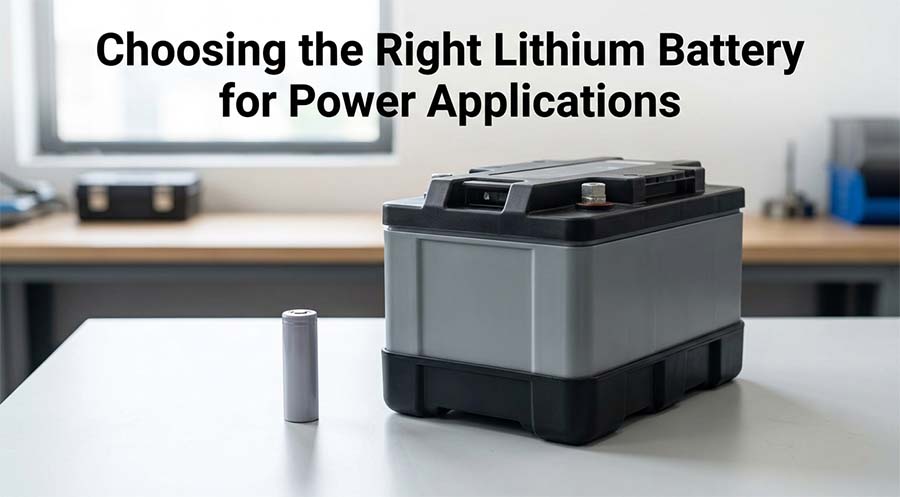
In reality, this is not true.
A lithium battery used in a smartphone, laptop, or small consumer device is very different from a lithium battery designed to power a commercial floor scrubber, mobility scooter, backup power system, or electric tool. Power applications place higher demands on discharge current, safety, thermal control, cycle life, and system stability.
For businesses, choosing the wrong lithium battery can cause more than inconvenience. It can lead to reduced equipment performance, unexpected downtime, higher maintenance costs, safety risks, and customer complaints. That is why understanding the difference between lithium battery types is essential before selecting a battery solution.
What Makes a Lithium Battery Suitable for Power Applications?
A power application usually requires the battery to deliver stable energy under medium to high load. This means the battery must support not only the required voltage and capacity, but also the actual working current of the equipment.
For example, a 24V 20Ah battery may look suitable on paper for a mobility device. But if the device requires a high peak current during startup or uphill movement, a low-discharge battery may not perform safely or consistently.
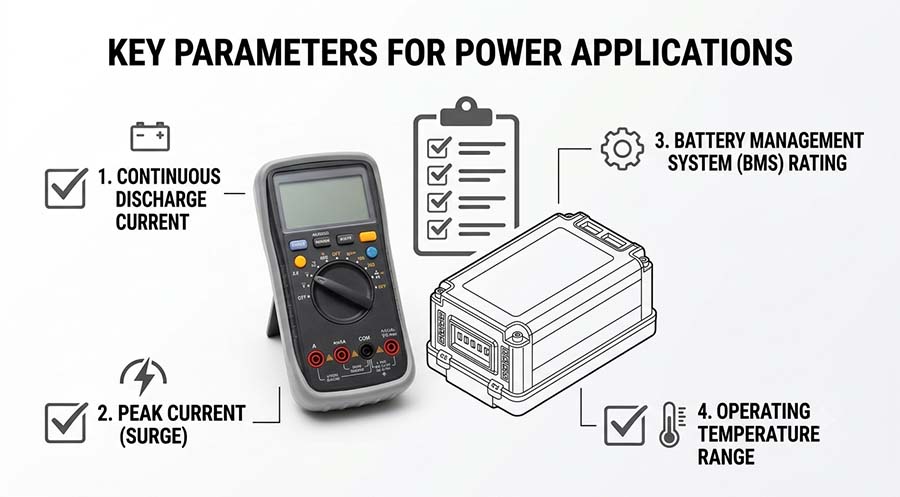
A lithium battery suitable for power applications should be evaluated by several core factors:
| Key Factor | Why It Matters for Power Applications |
| Voltage | Must match the equipment system, such as 12V, 24V, 36V, or 48V |
| Capacity | Determines runtime and energy storage |
| Continuous Discharge Current | Supports stable operation under normal load |
| Peak Discharge Current | Handles startup, acceleration, or sudden heavy load |
| BMS Protection | Protects against overcharge, over-discharge, short circuit, and overheating |
| Cycle Life | Affects long-term replacement cost |
| Operating Temperature | Important for outdoor, industrial, or extreme environments |
| Battery Cell Quality | Influences safety, consistency, and lifespan |
| Pack Design | Affects heat dissipation, vibration resistance, and installation fit |
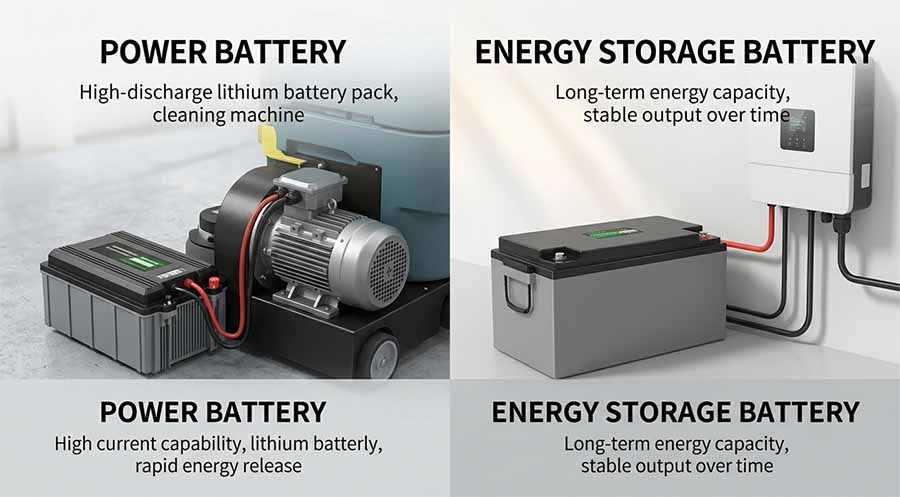
Power Battery vs. Energy Storage Battery vs. Consumer Lithium Battery
Different lithium batteries are designed for different purposes. Using the wrong type can cause poor performance even if the voltage looks correct.
| Battery Type | Main Purpose | Common Applications | Key Requirement |
| Power Lithium Battery | High-load output | Electric tools, mobility scooters, robots, cleaning machines, golf carts | High discharge current and strong BMS |
| Energy Storage Battery | Long runtime and stable storage | Solar systems, UPS, backup power, RV energy storage | Capacity, cycle life, and system stability |
| Consumer Lithium Battery | Compact energy for small electronics | Phones, laptops, tablets, cameras | Small size and high energy density |
| Custom Lithium Battery Pack | Application-specific power solution | Medical, industrial, outdoor, marine, OEM devices | Matched voltage, current, shape, connector, BMS, and certification |
Key Parameters to Check Before Choosing a Lithium Battery
When selecting a lithium battery for power applications, businesses should review the full electrical and environmental requirements of the equipment.
| Parameter | What to Check | Example |
| Nominal Voltage | Match the equipment voltage | 12V, 24V, 36V, 48V |
| Capacity | Calculate required runtime | 20Ah, 40Ah, 100Ah |
| Continuous Current | Match normal operating load | 30A continuous discharge |
| Peak Current | Support startup or surge load | 60A peak for 5 seconds |
| Cycle Life | Estimate long-term use | 2,000+ cycles depending on chemistry and use |
| BMS Rating | Ensure safe protection | Overcurrent, short circuit, temperature protection |
| Charging Method | Match charger voltage and current | 29.2V charger for 24V LiFePO4 system |
| Operating Temperature | Check work environment | Outdoor equipment may require low-temperature support |
| Size and Weight | Fit the battery compartment | Custom housing or compact pack design |
| Connector Type | Match device interface | Anderson, XT60, DC plug, custom connector |
Application Scenarios
- Commercial Floor Cleaning Machine
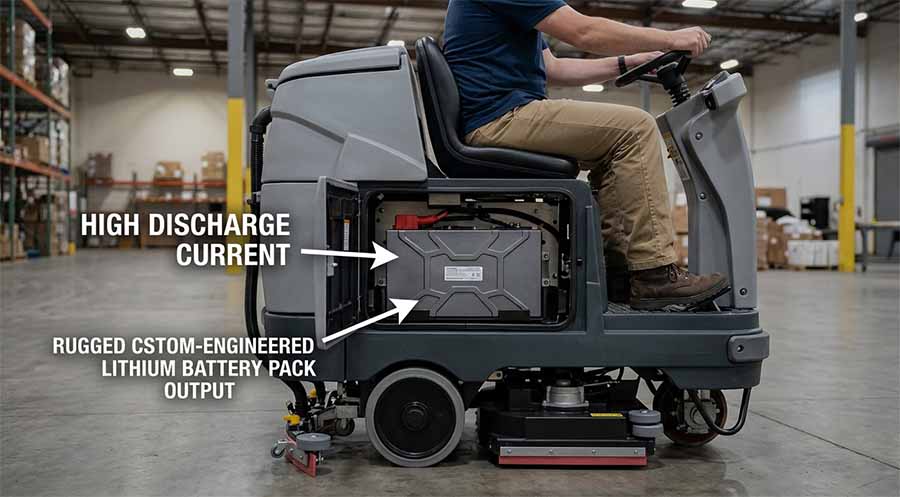
A commercial cleaning company in California uses battery-powered floor scrubbers for supermarkets, warehouses, and schools. The machine operates for 3–4 hours per shift and requires strong current output when the motor and brush system run together.
Typical battery requirement:
| Requirement | Example Specification |
| System Voltage | 24V |
| Capacity | 40Ah–60Ah |
| Continuous Discharge Current | 40A |
| Peak Current | 80A |
| Key Need | Stable high-current output and long cycle life |
A standard low-discharge lithium battery may shut down under heavy load. A power lithium battery with a properly rated BMS is a better solution.
- Solar Backup Power for a Home Office
A homeowner in Texas wants a battery system to support a home office during short power outages. The system needs to power a router, laptop, LED lights, and small electronics for several hours.
Typical battery requirement:
| Requirement | Example Specification |
| System Voltage | 48V |
| Capacity | 100Ah |
| Energy Storage | About 5.12kWh |
| Continuous Output | 2,000W inverter support |
| Key Need | Long runtime, safety, and cycle life |
In this case, energy storage performance is more important than high peak discharge. A LiFePO4 battery with long cycle life and stable BMS protection is often a strong choice.
- Medical Mobility Scooter
A senior user in Florida relies on a mobility scooter for daily transportation around the neighborhood, grocery store, and medical appointments. The battery must provide safe, stable performance and handle short peak loads when starting or climbing ramps.
Typical battery requirement:
| Requirement | Example Specification |
| System Voltage | 24V |
| Capacity | 20Ah–30Ah |
| Continuous Discharge Current | 25A |
| Peak Current | 50A |
| Key Need | Safety, reliability, and stable output |
For medical mobility use, battery stability is critical. The BMS must protect against over-discharge, overcurrent, short circuit, and overheating.
- Outdoor Work Equipment
A landscaping contractor in Colorado uses battery-powered equipment in changing outdoor temperatures. The battery must handle vibration, temperature changes, and repeated high-power output.
Typical battery requirement:
| Requirement | Example Specification |
| System Voltage | 36V |
| Capacity | 30Ah |
| Continuous Discharge Current | 50A |
| Peak Current | 100A |
| Key Need | High discharge rate, durable structure, and temperature performance |
For outdoor power equipment, battery pack design, cell consistency, and thermal protection are extremely important.
How to Select the Right Lithium Battery Solution
To choose the right lithium battery for a power application, start with the actual equipment requirement rather than the battery label.
First, confirm the voltage of the system. The battery voltage must match the equipment and charger. Then calculate the required runtime based on the equipment’s power consumption. For example, if a device uses 500W and needs to run for 4 hours, the system needs at least 2,000Wh of usable energy, plus additional margin.
Next, check the continuous and peak current requirements. This is where many mistakes happen. A battery may have enough capacity but still fail because the BMS cannot support the equipment’s current demand.
You should also consider the working environment. Indoor backup power, outdoor equipment, medical mobility, marine use, and industrial robots all have different needs for temperature resistance, vibration resistance, housing design, connectors, and safety standards.
A good selection process should include:
| Step | What to Do |
| 1 | Confirm voltage and equipment type |
| 2 | Calculate runtime and capacity |
| 3 | Check continuous current and peak current |
| 4 | Review operating temperature and environment |
| 5 | Match charger and BMS requirements |
| 6 | Confirm battery size, weight, and connector |
| 7 | Consider custom pack design if standard batteries do not fit |
| 8 | Work with an experienced lithium battery manufacturer |
For OEM and commercial users, a custom lithium battery pack can often reduce long-term problems because the battery is designed around the equipment instead of forcing the equipment to adapt to a generic battery.
Common Mistakes to Avoid
One of the biggest mistakes is choosing a lithium battery based only on amp-hours. Capacity is important, but it does not tell you whether the battery can safely support high current output.
Another mistake is using consumer-grade lithium batteries for industrial or commercial power equipment. These batteries may not have the correct BMS rating, discharge capability, or structural design.
Businesses should also avoid ignoring charger compatibility. A mismatched charger can reduce battery life or create safety issues. In addition, temperature is often overlooked. A battery used in a warm indoor office does not face the same conditions as one used in outdoor work equipment or warehouse machinery.
The most common mistakes include:
- Only comparing Ah capacity
- Ignoring continuous discharge current
- Ignoring peak current requirements
- Using consumer batteries for commercial equipment
- Choosing a battery without proper BMS protection
- Overlooking operating temperature
- Forgetting charger compatibility
- Not considering vibration, housing, or connector design
- Buying a standard pack when a custom pack is required
About HiMAX Battery
HiMAX is one of the leading battery manufacturers serving global commercial, industrial, medical, solar, backup power, and OEM customers. With years of experience in lithium battery design and production, HiMAX provides reliable battery solutions for a wide range of power applications.
From standard lithium battery packs to fully customized solutions, HiMAX helps customers match the right battery chemistry, voltage, capacity, BMS, connector, structure, and performance requirements for their equipment. Whether you need batteries for commercial machines, mobility devices, solar energy systems, emergency backup power, outdoor equipment, or industrial applications, HiMAX can support your project with professional engineering and manufacturing capabilities.
When not all lithium batteries are suitable for power applications, choosing the right battery partner becomes essential. HiMAX is committed to delivering safe, efficient, and application-ready lithium battery solutions for customers around the world.
Find articles related to LiFePO4 Batteries
- Emergency Flashlight Battery Buying Guide
- 2026 Online Buying Guide for Camping Lanterns Batteries
- 2026 Online Buying Guide for Electric Sightseeing Vehicle Batteries
- How to Choose the Right Battery Solution for Electric Boat
- The Forestry Agencies’ Secret: Why It’s Finally Time to Switch to LiFePO4 Batteries for Forest Monitoring Systems
- Security Check Inquiry: Why Don’t Portable Power Banks Use Lithium Iron Phosphate (LiFePO₄) Batteries?
- Hospital Procurement Department Tip: Why It’s Time to Equip Your Portable Ventilators with Rechargeable Lithium Iron Phosphate (LiFePO₄) Batteries
- From Lead-Acid to LFP: Why Forklift Operators Are Making the Switch Right Now