Key Takeaways
- Forklift operators are moving from lead-acid batteries to LFP forklift batteries because warehouse, logistics, manufacturing, and distribution operations need cleaner charging, lower maintenance, faster energy recovery, and better uptime.
- Lead-acid batteries can still work in simple single-shift environments, but many modern facilities now run longer hours, tighter schedules, higher labor costs, and more demanding safety standards.
- LFP, also known as lithium iron phosphate, gives forklift fleets a practical path to reduce battery watering, lower battery change labor, support opportunity charging, improve energy efficiency, and simplify daily operations.
- For enterprise buyers, the real question is no longer whether LFP batteries are only a premium upgrade. The better question is how much downtime, labor, maintenance, and operational friction a lead-acid system is still creating.
The Forklift Battery Shift Is Happening for a Reason
For decades, lead-acid batteries powered electric forklifts across American warehouses and factories. They were familiar. They were widely available. Maintenance teams knew how to water them, charge them, equalize them, and replace them when needed.
But warehouse operations have changed.
Today, many facilities operate two or three shifts. E-commerce fulfillment centers need faster turnaround. Cold storage buildings must protect temperature-sensitive inventory. Food and beverage operations must follow strict hygiene rules. Manufacturing plants need reliable material movement between production lines. Retail distribution centers need more uptime with fewer labor interruptions.
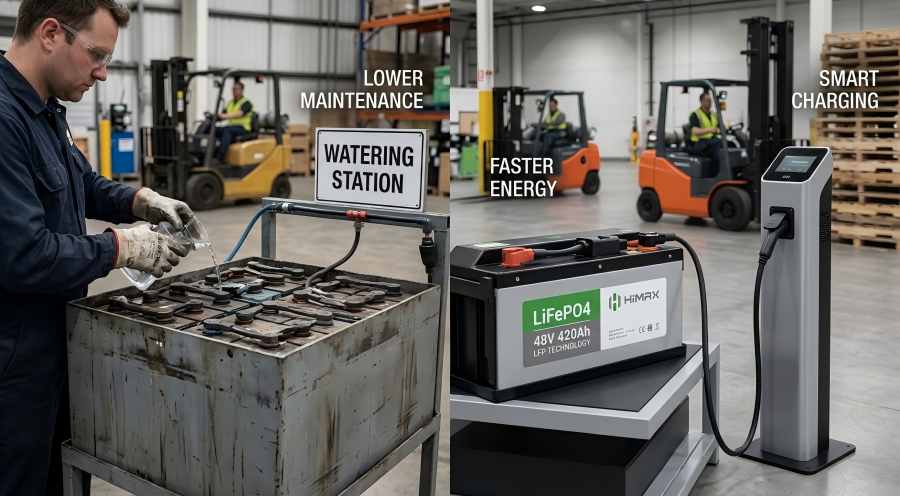
In this environment, the old lead-acid battery routine can become a bottleneck. Operators may need to swap batteries during a shift. Maintenance teams may need to water batteries on schedule. Charging rooms may require ventilation and dedicated space. A weak battery can reduce forklift performance before the workday ends.
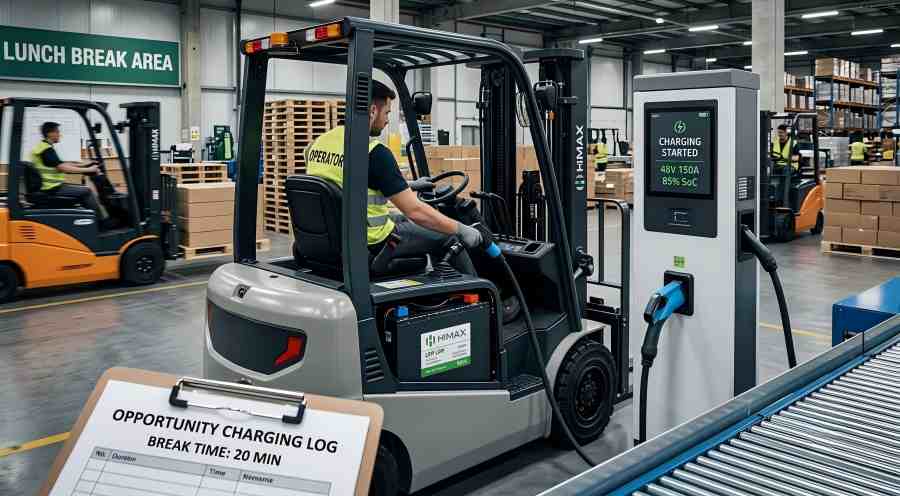
LFP forklift batteries change this model. They are designed for faster charging, lower routine maintenance, and more flexible energy use. Instead of removing a heavy battery for every long recharge cycle, operators can charge during breaks, lunches, shift changes, and idle windows. This is why more forklift operators are making the switch right now.
Lead-Acid vs. LFP Forklift Batteries: Industry Solution View
The forklift battery decision should not be based only on purchase price. It should be based on total operating value. A battery is not just a component inside a forklift. It affects labor planning, charging room design, safety procedures, shift scheduling, productivity, maintenance, and fleet availability.
| Comparison Area | Lead-Acid Forklift Battery | LFP Forklift Battery | Operational Impact |
| Routine maintenance | Requires watering, cleaning, equalization, and inspection | No watering required and lower daily maintenance | Less labor and fewer maintenance interruptions |
| Charging time | Often requires long charge and cooling periods | Supports faster charging and opportunity charging | Better uptime during multi-shift operations |
| Battery swapping | Often needed in heavy multi-shift use | Often reduced or avoided with planned charging | Less handling of heavy batteries |
| Charging area | May need dedicated space and ventilation | More flexible charging setup when properly designed | Better use of warehouse floor space |
| Energy efficiency | Lower efficiency due to charging losses and heat | Higher energy efficiency in many applications | Lower electricity waste over time |
| Performance consistency | Voltage can drop as the battery discharges | More stable output over the discharge cycle | More consistent forklift performance |
| Cycle life | Can be shortened by poor maintenance or deep discharge | Long cycle life when managed by a proper BMS | Better long-term value for high-use fleets |
| Safety management | Acid handling and gas ventilation must be managed | Requires BMS, charger matching, and thermal protection | Different safety model with less acid-related work |
| Best fit | Single-shift, low-utilization, budget-sensitive fleets | Multi-shift, high-use, uptime-focused fleets | LFP is stronger when downtime is expensive |
This table shows why forklift operators are looking beyond the battery price tag. The stronger solution is the one that supports the way the facility actually works.
Why Lead-Acid Is Becoming Harder to Justify
Lead-acid forklift batteries can still be useful in some operations. If a facility runs one shift per day, has a stable charging room, and has maintenance staff available, lead-acid may still meet basic needs.
The problem appears when operations get busier.
Lead-acid batteries require regular watering. If the water level is too low, battery life can suffer. If watering is done incorrectly, maintenance risk increases. Lead-acid batteries also need proper charging and cooling. In many high-use facilities, one forklift may require more than one battery to stay in service through multiple shifts.
Battery swapping creates its own issues. Workers need time to remove and install heavy battery packs. The facility needs equipment for battery handling. There is also risk from acid exposure, spills, incorrect handling, and damaged connectors.
These issues create hidden costs. The battery may look cheaper at purchase, but the facility pays through labor, downtime, space, maintenance, safety procedures, and reduced productivity.
Why LFP Forklift Batteries Fit Modern Operations
LFP batteries are becoming popular because they solve several practical problems at once.
They support faster charging. This means forklifts can recover useful energy during short breaks. A 20-minute opportunity charge during lunch or shift change can help keep equipment moving through the day.
They require less routine maintenance. Operators do not need to water cells. Maintenance teams spend less time cleaning acid residue, checking electrolyte levels, or managing equalization schedules.
They deliver more consistent power. LFP batteries can maintain stable performance through much of the discharge cycle. Operators can feel this when a forklift continues to lift, travel, and accelerate more consistently near the end of the shift.
They use a battery management system. A proper BMS monitors voltage, current, temperature, state of charge, and system protection. This helps the battery operate within safe limits.
They also help simplify fleet planning. Instead of buying extra lead-acid batteries for battery swapping, some facilities can use fewer LFP packs with smarter charging schedules.
Business Case: Uptime, Labor, and Space
For forklift operators, the switch to LFP is often about uptime.
If a forklift sits idle because the battery is charging, the fleet is not producing value. If workers spend time changing batteries, they are not moving pallets. If supervisors must plan around charge times and battery rotation, the battery system is controlling the operation instead of supporting it.
LFP batteries can reduce that friction. They allow charging to become part of the natural workflow. A forklift can charge during operator breaks, lunch periods, loading pauses, and shift transitions. This makes energy management more flexible.
Space is another factor. Lead-acid operations may need a dedicated charging room, battery racks, watering equipment, ventilation, eyewash stations, and battery handling tools. LFP systems can reduce some of that infrastructure when properly installed and approved for the facility.
The result is not just a better battery. It is a simpler material handling system.
Use Case 1: Ohio E-Commerce Fulfillment Center
An e-commerce fulfillment center near Columbus, Ohio operates 18 hours per day. The site uses 36 electric forklifts and reach trucks. Each truck averages 5.5 operating hours per shift, with heavy movement during inbound receiving and outbound trailer loading.
The original lead-acid setup used 48V battery packs. The facility kept extra batteries for rotation because the forklifts could not complete long operating days on one battery. Workers spent about 25 minutes per battery change, including travel, removal, installation, and inspection.
A practical LFP solution would use 48V LFP forklift battery packs with a charger plan built around break periods. Each forklift could receive opportunity charging during two 20-minute breaks and one 45-minute lunch or shift transition window.
Key parameters:
Fleet size: 36 forklifts and reach trucks
Battery platform: 48V LFP forklift battery system
Operating time: 18 hours per day
Opportunity charging windows: 20 minutes + 20 minutes + 45 minutes
Main goal: Reduce battery swapping and increase forklift availability
Expected operational benefit: Less battery handling, fewer backup batteries, and better equipment uptime during outbound peaks
For this facility, LFP is not just a battery upgrade. It is a workflow improvement.
Use Case 2: Texas Food and Beverage Warehouse
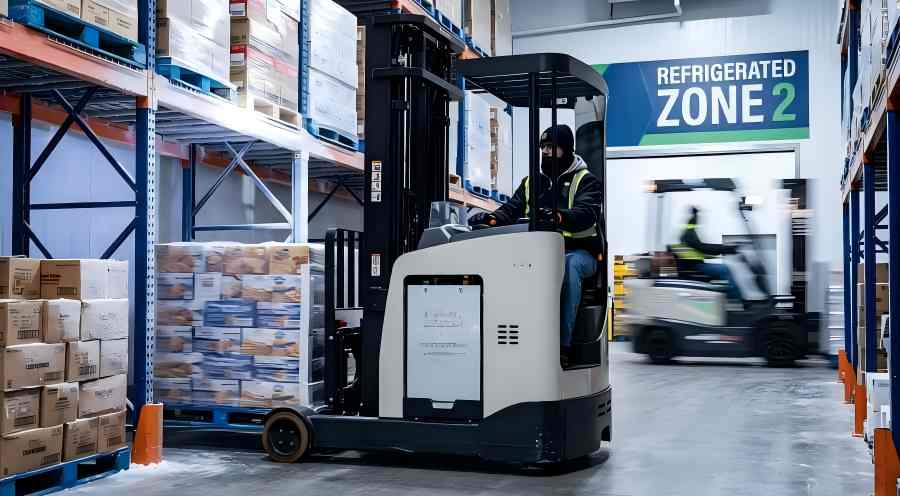
A food and beverage distributor in Dallas, Texas runs refrigerated and dry warehouse zones. The company uses 24 forklifts across two shifts. The forklifts move pallets between receiving docks, cold rooms, staging areas, and delivery trucks.
Lead-acid batteries create two pain points. First, battery maintenance requires labor. Second, battery rooms and acid handling are not ideal near food-related operations.
The distributor considers switching to 80V LFP forklift batteries for its higher-capacity lift trucks and 48V LFP batteries for smaller warehouse units. The goal is to reduce maintenance and improve charging flexibility.
Key parameters:
Fleet size: 24 forklifts
Battery platforms: 48V and 80V LFP systems
Operating environment: Refrigerated and dry warehouse zones
Daily operation: Two shifts, six days per week
Main goal: Lower maintenance, cleaner charging, and better uptime
Charging strategy: Fast charging during shift breaks and dock scheduling gaps
For food and beverage operations, the cleaner daily process can matter as much as the energy performance. A no-watering battery system can help simplify maintenance procedures and reduce operational mess.
Use Case 3: California Third-Party Logistics Facility
A third-party logistics company in Riverside, California handles consumer goods, imported inventory, and regional distribution. The facility runs 52 forklifts and pallet handling vehicles. It operates nearly 24 hours per day during peak season.
The lead-acid system requires a battery room, trained battery change staff, and extra battery inventory. During seasonal peaks, the battery room becomes a scheduling bottleneck. Some forklifts wait for batteries while dock doors are full and trucks are queued outside.
The company evaluates LFP batteries with centralized smart chargers placed near natural parking and staging areas. The goal is to reduce battery room traffic and support more flexible forklift availability.
Key parameters:
Fleet size: 52 material handling vehicles
Peak season operation: Up to 24 hours per day
Battery platform: 48V LFP for most warehouse trucks
Charging method: Opportunity charging near staging zones
Main goal: Reduce battery room bottlenecks and support continuous operation
Expected operational benefit: Less downtime during peak shipping windows
This is a common reason 3PL operators consider LFP. When delivery schedules are tight, battery downtime becomes expensive very quickly.
Use Case 4: Georgia Manufacturing Plant
A manufacturing plant near Atlanta, Georgia uses forklifts to move raw materials, work-in-progress inventory, and finished products. The plant has 16 forklifts and runs two production shifts.
The plant manager is concerned about production interruption. When a forklift loses power during a production run, it can delay material flow to the line. Lead-acid performance also feels weaker late in the shift, especially on trucks that handle heavier loads.
The plant evaluates 80V LFP forklift batteries for high-load trucks and 48V LFP batteries for general material movement. The solution includes chargers near production support areas so operators can charge during natural idle time.
Key parameters:
Fleet size: 16 forklifts
Battery platforms: 48V and 80V LFP
Load type: Raw materials, WIP, finished goods
Operating schedule: Two shifts per day
Main goal: Stable power delivery and production continuity
Charging window: Breaks, lunch, shift change, and line changeover periods
For manufacturing, the business case is simple. A more reliable forklift fleet supports a more reliable production flow.
How to Choose the Right LFP Forklift Battery
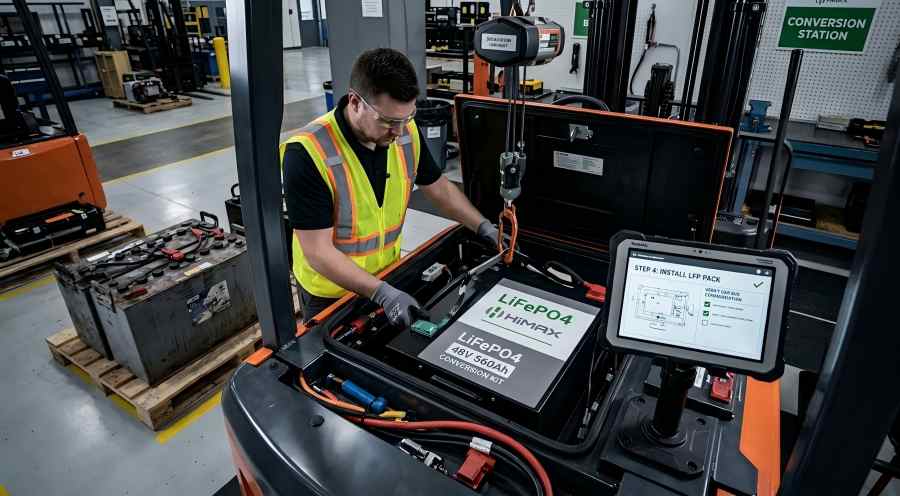
A successful lead-acid to LFP conversion requires more than replacing one battery with another. The battery must match the forklift, charger, duty cycle, weight requirement, communication system, and operating environment.
Fleet managers should confirm the following details:
- Forklift voltage class, such as 24V, 36V, 48V, or 80V.
- Battery compartment dimensions.
- Required counterweight.
- Average and peak current demand.
- Shift length and daily operating hours.
- Charging windows and charger locations.
- Indoor or outdoor use.
- Temperature range.
- Connector type.
- CAN communication needs, if required.
- BMS protection settings.
- Certification and safety requirements.
A good supplier should review the forklift model, duty cycle, and charging plan before recommending a battery. This reduces the risk of mismatch and helps the fleet get the full value of LFP technology.
FAQ: Lead-Acid to LFP Forklift Battery Conversion
- Are LFP forklift batteries better than lead-acid batteries?
LFP forklift batteries are often better for high-use, multi-shift, and uptime-focused operations. They reduce watering, support faster charging, and can lower daily maintenance. Lead-acid may still work for simple, low-use, single-shift fleets.
- Do LFP forklift batteries need watering?
No. LFP batteries do not require watering like lead-acid batteries. This is one of the main reasons warehouse and logistics operators switch to LFP.
- Can LFP forklift batteries be opportunity charged?
Yes. Opportunity charging is one of the major advantages of LFP forklift batteries. Facilities can charge during breaks, lunch, shift changes, and other idle periods.
- Do LFP batteries need a special charger?
Yes. LFP batteries should be charged with a charger designed or approved for the specific battery system. Using the wrong charger can reduce performance or create safety risk.
- Are LFP forklift batteries safe?
LFP chemistry is widely valued for thermal stability and safety performance, but the full system still matters. A safe solution needs quality cells, a strong BMS, correct charger matching, proper installation, and clear operating procedures.
- How long do LFP forklift batteries last?
Service life depends on battery design, depth of discharge, charging behavior, temperature, duty cycle, and maintenance practices. In high-use fleets, LFP often offers longer practical service life than poorly maintained lead-acid systems.
- Is LFP worth the higher upfront cost?
For many multi-shift and high-utilization fleets, yes. The value comes from reduced maintenance, less battery swapping, better uptime, potential energy savings, and improved operating flexibility.
HiMAX’s LiFePO4 Batteries
HiMAX is one of the world’s leading battery manufacturers, providing reliable battery solutions for industrial equipment, electric mobility, commercial energy storage, material handling systems, consumer electronics, medical devices, smart hardware, IoT products, backup power, and custom battery applications. With strong engineering support, flexible customization, strict quality control, and experience in LiFePO4 batteries, lithium-ion battery packs, lithium polymer batteries, and rechargeable power systems, HiMAX helps businesses select the right battery solution for real-world performance, safety, and long-term value. For companies planning forklift battery upgrades, lead-acid to LFP conversion projects, or custom industrial battery systems, HiMAX offers a trusted manufacturing partner from design review to sample testing and mass production.
Find articles related to LiFePO4 Batteries
- Emergency Flashlight Battery Buying Guide
- 2026 Online Buying Guide for Camping Lanterns Batteries
- 2026 Online Buying Guide for Electric Sightseeing Vehicle Batteries
- How to Choose the Right Battery Solution for Electric Boat
- The Forestry Agencies’ Secret: Why It’s Finally Time to Switch to LiFePO4 Batteries for Forest Monitoring Systems
- Security Check Inquiry: Why Don’t Portable Power Banks Use Lithium Iron Phosphate (LiFePO₄) Batteries?
- Hospital Procurement Department Tip: Why It’s Time to Equip Your Portable Ventilators with Rechargeable Lithium Iron Phosphate (LiFePO₄) Batteries