Key Takeaways
- Commercial PV systems can reduce electricity costs, but solar power is intermittent. Production changes with clouds, weather, season, and time of day.
- Energy storage helps commercial solar users avoid the intermittency trap by storing excess solar energy and releasing it when solar output drops or electricity demand rises.
- A battery energy storage system can support peak shaving, load shifting, backup power, demand charge reduction, and better use of on-site solar generation.
- For commercial facilities, the best solution is not just “more solar panels.” The better solution is a PV-plus-storage system sized around load profile, utility rate structure, operating hours, backup needs, and future expansion.
- Businesses such as warehouses, schools, factories, supermarkets, offices, farms, and EV charging sites can benefit from commercial energy storage when the system is properly designed.
- A strong battery partner helps commercial customers select the right battery chemistry, voltage platform, capacity, safety design, thermal control, and system configuration.
The Intermittency Trap in Commercial PV Systems
Commercial solar power can look simple on paper. A business installs photovoltaic panels. The panels generate electricity during the day. The business uses that energy to reduce utility bills. The system looks clean, quiet, and cost-effective.
But real-world commercial energy use is rarely that simple.
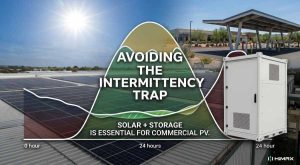
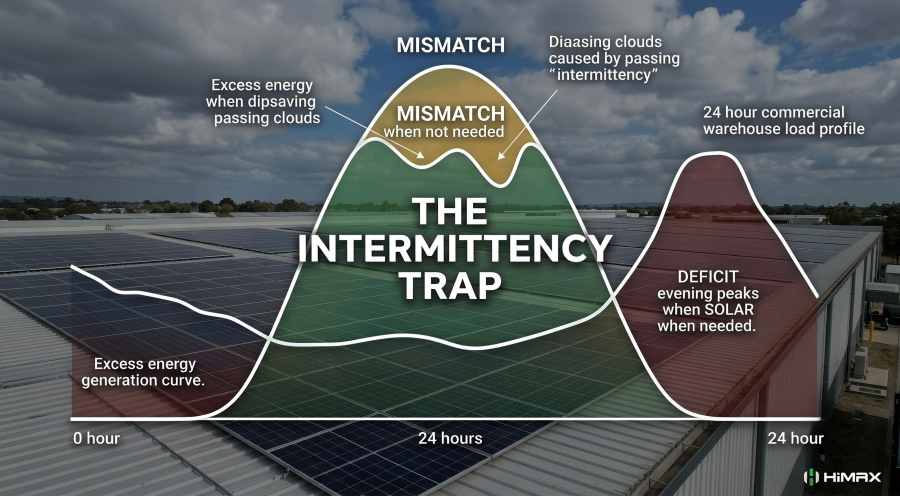
Solar production changes throughout the day. It rises in the morning, peaks around midday, and drops in the afternoon. It also changes when clouds pass over the building. It drops during storms. It is lower in winter in many U.S. regions. It produces nothing at night.
Commercial loads also move in their own patterns. A warehouse may use more power in the early morning and evening. A supermarket may run refrigeration all day and all night. A factory may have heavy motor loads during production shifts. An office may peak when HVAC demand is high in the afternoon. An EV charging site may see heavy demand after work hours, when solar generation is already falling.
This mismatch creates the intermittency trap. A company may invest in a solar PV system, but still pay high electricity bills because solar generation does not always match the facility’s real demand.
Energy storage solves this problem by making solar power more controllable. A battery energy storage system can capture excess solar energy when production is strong. It can then release that energy when solar output is weak, utility rates are high, or the facility needs backup support.
Why Energy Storage Changes the Value of Commercial Solar
Without energy storage, a commercial PV system must use solar energy as it is produced. If the facility cannot use all the solar power at that moment, the extra energy may be exported to the grid. In some utility markets, the export value may be lower than the value of using that power on-site.
With energy storage, the business can keep more of its solar energy. The system can charge the battery during strong solar hours and discharge during expensive or high-demand periods.
This creates several business benefits.
The facility can reduce demand charges by discharging the battery during short power peaks.
The facility can shift solar energy from midday to late afternoon or evening.
The facility can improve backup readiness during grid outages.
The facility can reduce reliance on diesel generators for short backup events.
The facility can use more of its own solar power instead of sending it to the grid.
The facility can prepare for future loads such as EV chargers, automation equipment, and larger HVAC systems.
For many commercial users, solar alone is a generation asset. Solar plus storage becomes an energy management asset.
Commercial PV Without Storage vs. PV Plus Storage
The table below shows how energy storage changes the performance of a commercial PV project.
| Area | PV System Without Storage | PV System With Energy Storage |
| Solar production control | Limited control. Energy must be used or exported when generated. | Better control. Energy can be stored and used later. |
| Peak demand management | Limited ability to reduce sudden demand spikes. | Battery can discharge during peak load periods. |
| Evening energy use | Solar production drops before many businesses close. | Stored solar can support evening operations. |
| Backup power | Solar usually needs special design to operate during outages. | Battery can support critical loads when configured for backup. |
| Grid dependence | Still high during non-solar hours. | Lower grid dependence during selected hours. |
| Exported solar | Excess energy may be exported at lower value. | More energy can be used on-site. |
| Utility bill control | Helps reduce energy consumption charges. | Can help reduce energy charges and demand charges. |
| Resilience | Limited resilience. | Higher resilience for critical operations. |
| Long-term flexibility | Harder to support new loads. | Easier to support EV charging and load growth. |
How Commercial Battery Storage Works With PV Systems
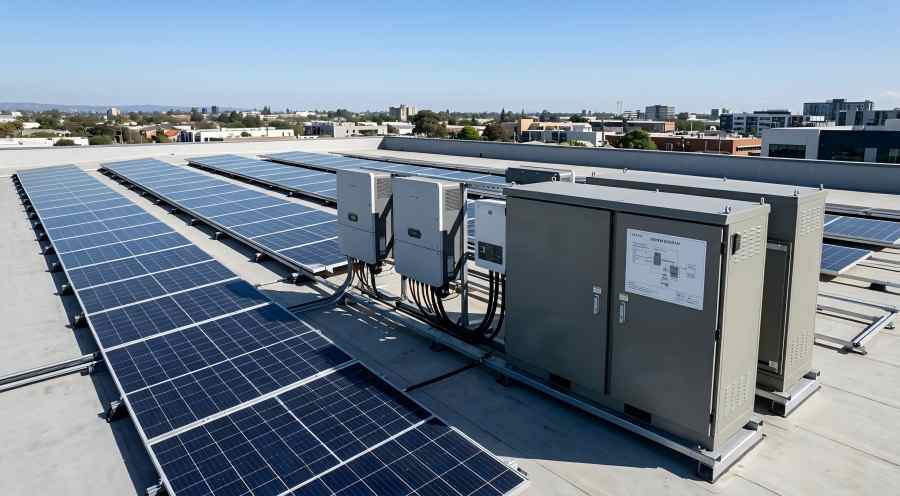
A commercial PV-plus-storage system usually includes solar panels, inverters, battery modules, a battery management system, power conversion equipment, safety protection, and an energy management system.
The solar panels generate DC electricity from sunlight. The inverter converts power for the facility or grid. The battery system stores energy. The energy management system decides when to charge and discharge based on system settings, load demand, solar output, and utility rate structure.
A simple operating strategy may look like this:
Morning: The PV system begins generating power. The facility uses solar energy directly.
Midday: Solar output increases. If the facility load is lower than solar production, the extra energy charges the battery.
Afternoon: Facility demand rises due to HVAC, production equipment, lighting, or charging loads. The battery discharges to reduce grid demand.
Evening: Solar production drops. The battery can continue supporting selected loads or reduce purchases during higher-rate periods.
Outage event: If the system is designed for backup, the battery can power critical loads for a defined period.
This basic logic can be customized for different commercial users. A supermarket may prioritize refrigeration backup. A warehouse may prioritize peak shaving. A school may prioritize daytime solar use and emergency power. A factory may prioritize demand charge reduction and production continuity.
Industry Solution: Start With the Load Profile, Not the Battery Size
A common mistake is to start with a battery size before understanding the facility. A better approach starts with the commercial load profile.
The load profile tells the project team when the facility uses electricity and how much it uses. It also shows peak demand events, operating hours, standby loads, and seasonal patterns.
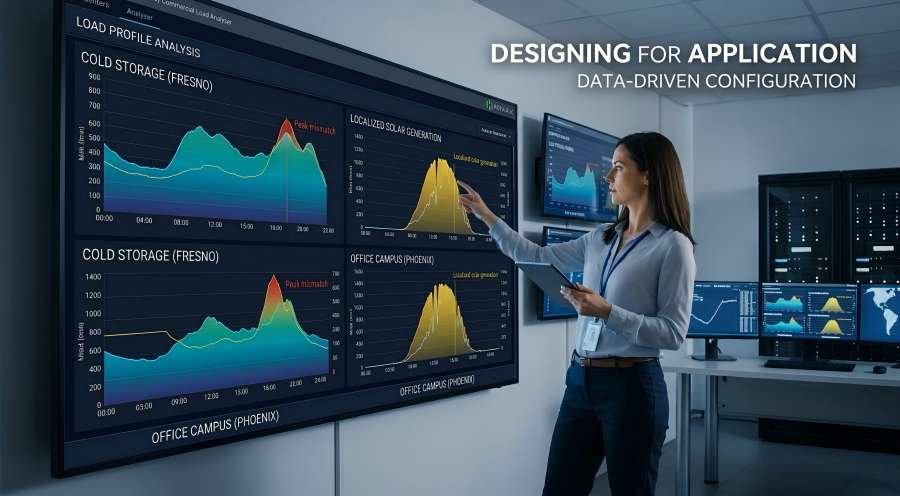
A good commercial PV-plus-storage design should answer these questions:
- What is the average daily electricity use?
- What is the peak demand in kW?
- When do peaks occur?
- How much solar energy is generated each hour?
- How much solar energy is exported?
- What is the utility rate structure?
- Are demand charges a major part of the bill?
- Does the facility need backup power?
- Which loads are critical during outages?
- How long should backup power last?
- Will the business add EV chargers or new equipment later?
Key Design Parameters for Commercial PV Energy Storage
| Design Parameter | Why It Matters | Example Commercial Range |
| PV system size | Defines solar generation capacity. | 100 kW to 2 MW for many commercial sites |
| Battery power rating | Defines how much power the battery can discharge at once. | 50 kW to 1 MW+ |
| Battery capacity | Defines how long the battery can support loads. | 100 kWh to several MWh |
| Discharge duration | Shows how many hours the battery can supply rated power. | 2 to 4 hours for many commercial projects |
| Critical load size | Defines backup requirement during outages. | 20 kW to 500 kW+ |
| Peak demand | Determines demand charge reduction opportunity. | Depends on facility type |
| Operating hours | Affects when stored energy is most valuable. | Daytime, evening, 24/7, or shift-based |
| Rate structure | Determines value of time shifting and peak shaving. | TOU rates, demand charges, export rates |
| Battery chemistry | Affects safety, cycle life, cost, and design. | LiFePO4 is common for stationary storage |
| Thermal management | Helps protect performance and service life. | Air or liquid cooling depending on system scale |
| EMS strategy | Controls charge and discharge behavior. | Peak shaving, backup, self-consumption, TOU |
Scenario Applications
Use Case 1: California Cold Storage Warehouse
A cold storage warehouse in Fresno, California operates seven days a week. The facility has a 750 kW commercial PV system on the roof. Its average daily energy use is 4,800 kWh. Its peak demand reaches 920 kW during hot afternoons when refrigeration compressors and HVAC systems run at the same time.
Without energy storage, the solar system offsets a large share of daytime energy use. However, the facility still sees high demand charges because short afternoon peaks remain. It also exports some solar energy during low-load periods.
A better solution is to add a 500 kW / 1,500 kWh battery energy storage system. The battery charges from solar between 10:00 AM and 2:00 PM. It discharges between 3:00 PM and 7:00 PM to reduce demand peaks and support refrigeration loads.
Key parameters:
PV size: 750 kW
Battery size: 500 kW / 1,500 kWh
Critical load: 350 kW refrigeration and controls
Peak demand before storage: 920 kW
Target peak after storage: 650 kW to 700 kW
Main goal: Demand charge reduction and refrigeration resilience
In this case, energy storage helps the warehouse avoid the intermittency trap by moving solar energy into the most expensive and operationally important hours.
Use Case 2: Texas Manufacturing Plant
A light manufacturing plant near Dallas, Texas operates two shifts per day. The plant uses CNC machines, air compressors, lighting, ventilation, and office equipment. It has a 1 MW PV system and an average daily energy use of 6,500 kWh.
The plant’s peak load occurs when several production lines start at the same time. The peak can rise from 700 kW to 1,250 kW for short periods. Solar helps reduce daytime consumption, but it cannot always respond to sudden load spikes.
A PV-plus-storage design can include a 750 kW / 2,000 kWh battery system. The battery can discharge quickly during production startup and compressor cycling events. It can also charge during midday solar production.
Key parameters:
PV size: 1 MW
Battery size: 750 kW / 2,000 kWh
Peak load event: Up to 1,250 kW
Battery discharge window: 15 minutes to 3 hours depending on event
Main goal: Peak shaving, power stability, and better solar self-consumption
For this plant, the value of storage is not only in storing extra solar energy. The value also comes from controlling sudden peaks that create expensive demand charges.
Use Case 3: Florida Supermarket Chain
A supermarket in Orlando, Florida uses refrigeration, lighting, HVAC, point-of-sale systems, security systems, and food preparation equipment. The store operates from 6:00 AM to 11:00 PM, while refrigeration runs 24 hours a day.
The store has a 300 kW rooftop PV system. Its average daily energy use is 2,200 kWh. Its critical load requirement during an outage is about 120 kW for refrigeration, lighting, POS, and network systems.
Solar alone cannot protect the store at night or during cloudy periods. A battery system can help the store use more solar energy and support selected critical loads during short grid outages.
A practical design may include a 250 kW / 1,000 kWh battery system.
Key parameters:
PV size: 300 kW
Battery size: 250 kW / 1,000 kWh
Critical load: 120 kW
Backup target: 4 to 6 hours for selected loads
Main goal: Solar self-consumption, backup support, and food loss prevention
For a supermarket, the business case includes more than electricity savings. A short outage can cause product loss, customer disruption, and operational stress. Energy storage helps reduce that risk.
Use Case 4: Arizona Office Campus With EV Charging
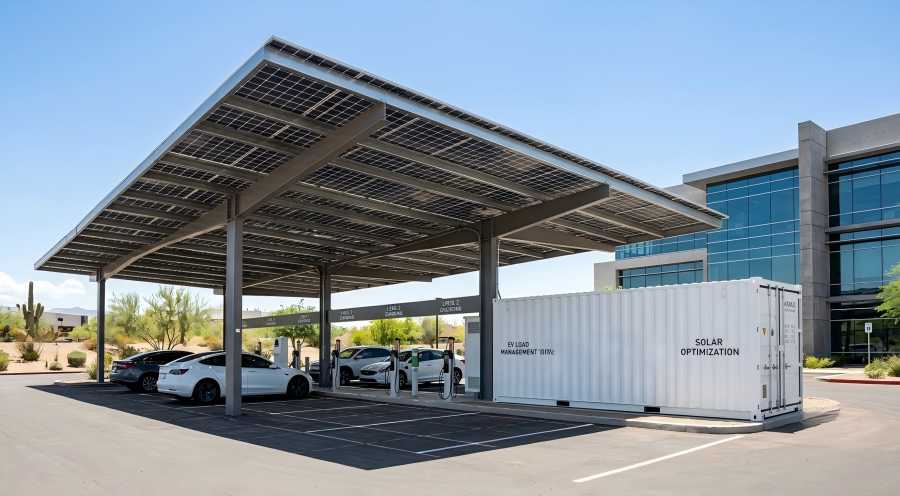
An office campus in Phoenix, Arizona has a 500 kW PV canopy system over its parking area. The building uses about 3,000 kWh per day. The company plans to install 24 Level 2 EV charging ports for employees and visitors.
The PV system generates strong daytime solar energy, but EV charging creates new load peaks. Many employees plug in after arriving in the morning. Visitors may charge during meetings. The site may also see higher HVAC loads during summer afternoons.
A 400 kW / 1,200 kWh battery system can help manage charging demand. It can charge from solar during midday and discharge when EV charging demand rises or building demand peaks.
Key parameters:
PV size: 500 kW
EV chargers: 24 Level 2 ports
Battery size: 400 kW / 1,200 kWh
Daily building load: 3,000 kWh
Main goal: EV load management, peak shaving, and solar optimization
This case shows how storage can help future-proof commercial PV systems. As companies electrify fleets and add chargers, battery storage can reduce stress on the grid connection and improve solar utilization.
What Businesses Should Evaluate Before Adding Storage
Energy storage should be treated as a business and engineering decision. A commercial buyer should evaluate both cost and operational value.
Important evaluation points include:
- Utility bill structure. If demand charges are high, storage may create strong value.
- Hourly load profile. Storage works best when there is a clear mismatch between solar output and energy demand.
- Solar export value. If exported solar is worth less than on-site use, storage can improve project economics.
- Backup needs. If the facility needs resilience, storage can support critical loads.
- Space and installation limits. Battery cabinets, inverters, transformers, and safety clearances require planning.
- Safety requirements. The system must include proper protection, monitoring, thermal control, and emergency response design.
- Battery life. Cycle life, depth of discharge, temperature, and operating strategy affect long-term value.
- A system should support future expansion when loads grow.
- Supplier capability. The battery partner should provide engineering support, quality control, customization, and long-term reliability.
Why LiFePO4 Is Often Used in Commercial Energy Storage
Many commercial stationary energy storage systems use lithium iron phosphate battery chemistry, also known as LiFePO4 or LFP. This chemistry is widely used because it offers a strong balance of safety, cycle life, thermal stability, and cost effectiveness.
For commercial PV systems, battery safety and long service life matter. The system may operate every day. It may charge and discharge hundreds or thousands of times over its service life. It may be installed near buildings, equipment, employees, or customers.
LiFePO4 batteries can be a strong fit for these conditions because they are designed for stable operation and long cycle performance. They are often used in energy storage cabinets, solar storage systems, backup power systems, and industrial power applications.
However, chemistry alone is not enough. A reliable commercial battery system also needs a strong battery management system, quality cells, proper module design, safe enclosure design, thermal management, and system-level testing.
The Role of the Battery Management System
The battery management system, or BMS, is one of the most important parts of a commercial battery storage solution. It monitors battery voltage, current, temperature, state of charge, and system health.
A good BMS helps protect the battery from overcharge, over-discharge, overcurrent, short circuit, and abnormal temperature. It also helps balance cells and improve system consistency.
For commercial PV storage, the BMS must communicate with the inverter and energy management system. This communication helps the system charge and discharge safely. It also helps operators monitor system performance.
A weak BMS can create reliability and safety risks. A strong BMS can help extend battery life, improve energy control, and support safer operation.
FAQ: Commercial PV Systems and Energy Storage
- Do all commercial PV systems need energy storage?
Not every system needs storage, but many commercial PV systems can benefit from it. Storage is especially useful when the facility has demand charges, time-of-use rates, low export value, backup needs, or a mismatch between solar generation and energy use.
- How large should a commercial battery storage system be?
The right size depends on the facility’s load profile, PV system size, peak demand, utility rate structure, backup needs, and business goals. A small business may need a few hundred kWh. A large facility may need several MWh.
- Can battery storage provide backup power during outages?
Yes, but the system must be designed for backup operation. The design must include critical load selection, proper controls, isolation equipment, inverter compatibility, and a clear backup duration target.
- Is solar plus storage better than solar alone?
For many commercial users, yes. Solar alone reduces daytime energy purchases. Solar plus storage gives the business more control by shifting energy, reducing peaks, and supporting resilience.
- Can storage help with EV charging?
Yes. Battery storage can reduce charging-related demand peaks, support solar-powered charging, and reduce stress on the grid connection. This is useful for offices, fleets, retail centers, and public charging locations.
- How should a business choose a battery supplier?
A business should choose a supplier with battery engineering experience, quality control, BMS capability, customization support, testing ability, safety knowledge, and reliable production capacity.
HiMAX Battery Energy Storage System
HiMAX is one of the world’s leading battery manufacturers, providing reliable battery solutions for commercial solar energy storage, industrial power systems, consumer electronics, medical devices, smart hardware, IoT products, electric mobility, backup power, and custom battery applications. With strong engineering support, flexible customization, strict quality control, and experience in LiFePO4 batteries, lithium-ion battery packs, lithium polymer batteries, and rechargeable energy storage systems, HiMAX helps businesses choose the right battery solution for real-world performance, safety, and long-term value. For companies planning commercial PV storage projects or custom battery systems, HiMAX offers a trusted manufacturing partner from design review to sample testing and mass production.
Find articles related to LiFePO4 Batteries
- Emergency Flashlight Battery Buying Guide
- 2026 Online Buying Guide for Camping Lanterns Batteries
- 2026 Online Buying Guide for Electric Sightseeing Vehicle Batteries
- How to Choose the Right Battery Solution for Electric Boat
- The Forestry Agencies’ Secret: Why It’s Finally Time to Switch to LiFePO4 Batteries for Forest Monitoring Systems
- Security Check Inquiry: Why Don’t Portable Power Banks Use Lithium Iron Phosphate (LiFePO₄) Batteries?
- Hospital Procurement Department Tip: Why It’s Time to Equip Your Portable Ventilators with Rechargeable Lithium Iron Phosphate (LiFePO₄) Batteries