With the rapid growth of new energy technologies and smart devices, batteries have become a core factor in determining product performance and competitiveness. Whether in consumer electronics, energy storage systems, or industrial equipment, different applications place very different demands on battery solutions.
When sourcing batteries, many companies face a key question: should you choose OEM, ODM, or a fully custom battery solution?
In this article, we’ll break down the fundamentals, use cases, and selection strategies to help you make a more informed decision.
What Are OEM, ODM, and Custom Battery Solutions?
Before choosing a battery solution, it’s essential to understand the differences between these three models.
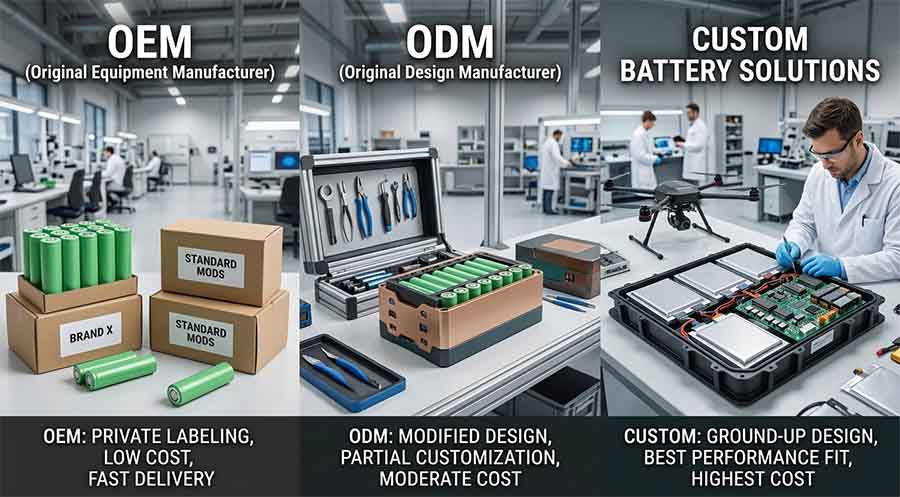
- OEM (Original Equipment Manufacturer)
OEM refers to using off-the-shelf battery products with simple branding (such as private labeling) or minimal adjustments.
Key features:
- Low cost
- Fast delivery
- Low technical barrier
Best for: standardized products or applications with modest performance requirements.
- ODM (Original Design Manufacturer)
ODM means the battery manufacturer provides an existing design, which can be partially modified to meet your needs.
Key features:
- متوسط development cycle
- Partial customization available
- Moderate cost
Best for: businesses that need some level of differentiation but have limited budgets.
- Custom Battery Solutions
A fully custom battery is designed from the ground up based on your product requirements—including cell selection, structure, and BMS (Battery Management System).
Key features:
- Best performance fit
- Higher technical complexity
- Higher cost
- Longer development cycle
Best for: products with strict requirements for safety, performance, and space constraints.
Key Factors to Consider When Choosing a Battery Solution
While every business has unique needs, the core decision factors typically include:
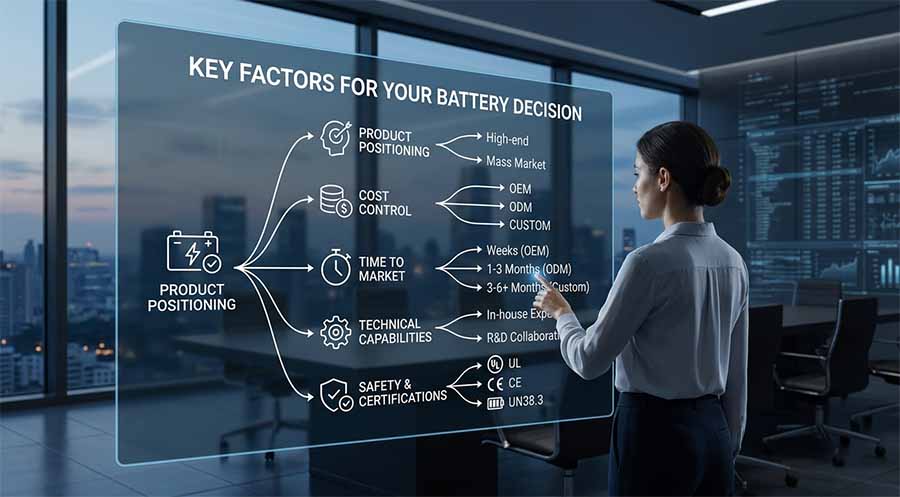
- Product Positioning & Market Demand
If your product targets the high-end market, custom batteries offer a clear advantage. For mass-market products, OEM solutions are often more practical.
- Cost Control
- OEM: lowest cost
- ODM: moderate cost
- Custom: highest cost
- Technical Capabilities & Resources
Do you have in-house expertise for battery selection and management? Do you have an R&D team to collaborate with suppliers? These factors will directly influence your choice.
- Time to Market
- OEM: fastest (within weeks)
- ODM: moderate (1–3 months)
- Custom: slower (3–6 months or longer)
- Safety & Certification Requirements
For example, certifications commonly required in the U.S.—such as UL, FCC, and UN38.3—can directly impact your battery selection.
Application Scenarios
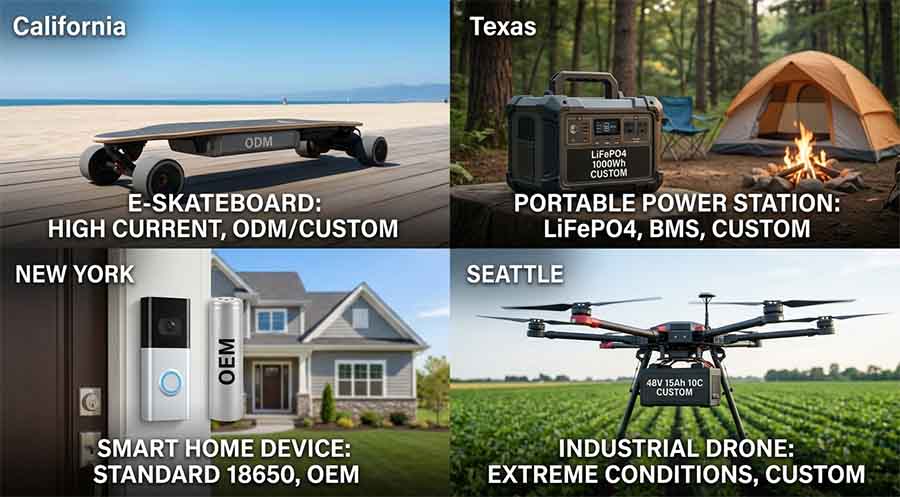
To better understand how these models apply in practice, let’s look at several real-world use cases in the U.S. market.
Scenario 1: Electric Skateboard (E-Skateboard)
- Location: California
- Voltage: 36V
- Capacity: 10Ah
- Peak current: 30A
- Operating temperature: 0–45°C
Recommended solution: ODM or custom
Why: Requires strong discharge performance and safety, with some size constraints.
Scenario 2: Portable Power Station
- Location: Camping users in Texas
- Battery type: LiFePO4
- Capacity: 500Wh–1000Wh
- Cycle life: 2000+ cycles
- Fast charging: Yes
Recommended solution: Custom battery
Why: Requires long lifespan, high safety, and integrated BMS.
Scenario 3: Smart Home Device
- Location: Residential users in New York
- Voltage: 3.7V
- Capacity: 2000mAh–3000mAh
- Discharge rate: ≤1C
- Size: Standard 18650
Recommended solution: OEM battery
Why: Highly standardized requirements and strong cost sensitivity.
Scenario 4: Industrial Drone
- Location: Agricultural monitoring in Seattle
- Voltage: 48V
- Capacity: 15Ah
- Discharge rate: 10C
- Operating environment: -10°C to 50°C
Recommended solution: Custom battery
Why: High discharge rates and extreme conditions demand superior safety and stability.
How to Choose the Right Battery Solution for Your Business
You can follow these steps to make a structured decision:
Step 1: Define Your Requirements
- Voltage, current, and capacity
- Size constraints
- Operating environment
Step 2: Evaluate Your Budget
- Can you afford custom development costs?
Step 3: Determine Your Product Timeline
- Do you need a fast time to market?
Step 4: Choose the Right Model
- Standard product → OEM
- Semi-custom → ODM
- High-end product → Custom
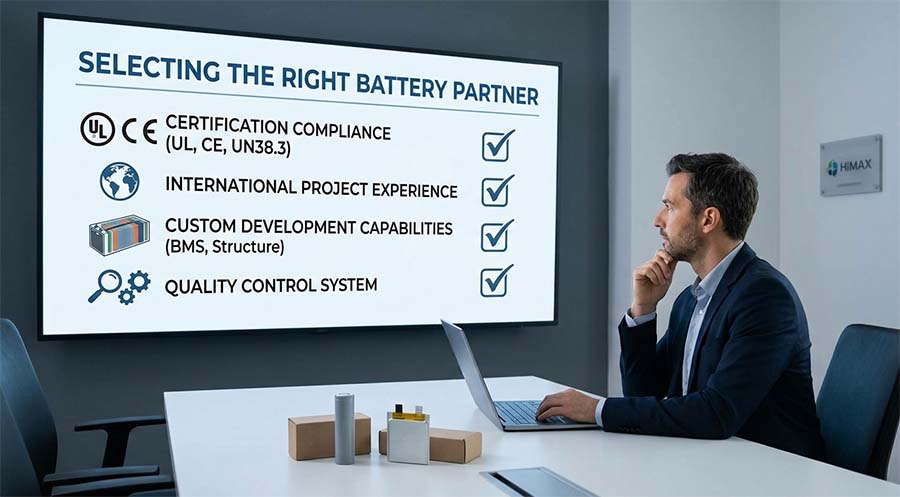
Step 5: Select the Right Supplier
Focus on:
- Certification compliance
- Experience with international projects
- Custom development capabilities
Conclusion
OEM, ODM, and custom battery solutions each have their own advantages and trade-offs. There is no absolute “best” option—only the one that best fits your specific needs.
By aligning your choice with your product positioning, budget, technical capabilities, and market requirements, you can make a smarter and more strategic decision.
Custom Battery Manufacturer — HiMAX
HiMAX is one of the world’s leading battery manufacturers, specializing in high-performance lithium battery solutions. We provide OEM, ODM, and fully customized battery services to customers worldwide, serving industries such as energy storage, consumer electronics, power tools, and industrial equipment.
With a mature R&D team and a strict quality control system, all HiMAX products comply with international certification standards such as UL, CE, and UN38.3. Whether you are a startup brand or an established enterprise, we can deliver safe, reliable, and cost-effective power solutions.
If you’re looking for a trusted battery partner, HiMAX is a choice you can rely on.
Find articles related to Custom Battery