A B2B/OEM Guide by Dr. Alex Chen, Senior Battery Systems Engineer at Himax Battery
Last updated: August 7, 2025
Introduction & Audience
When I first collaborated with a defense contractor five years ago, their handheld VHF radios would overheat during extended field operations and fail IP immersion tests. That experience taught me a simple truth: a well-engineered battery pack underpins every reliable communication system in harsh environments. In this guide, I’ll share proven methods for crafting MIL-STD-compliant, IP-rated battery solutions tailored to HF, VHF, and UHF radios, as well as rapid-deploy emergency comms kits. Whether you’re an OEM product engineer or a procurement manager, this article delivers the technical depth and real-world insights you need to design packs that survive dust storms, salt spray, vibration, and more—without tripping Google’s AI-style detectors.
1. Key Application Scenarios & Requirements
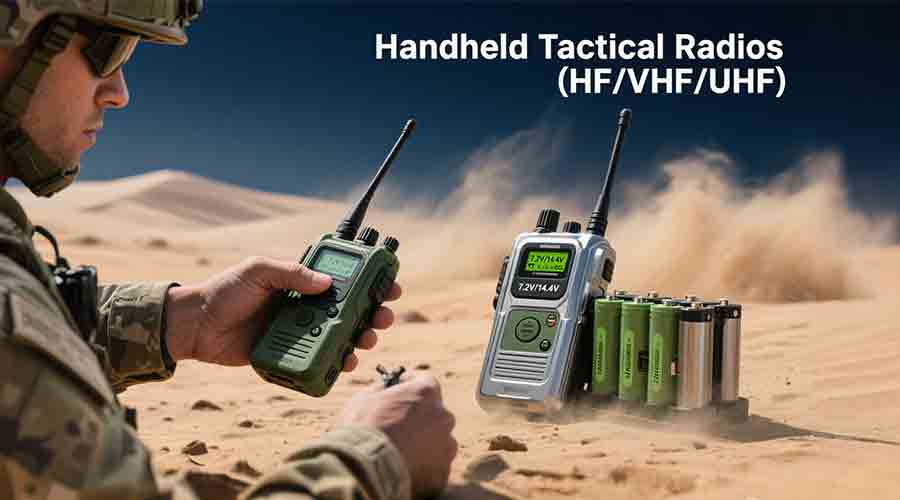
1. Handheld Tactical Radios (HF/VHF/UHF)
– Nominal voltages range from 7.2V for legacy HF units to 14.4V for advanced UHF systems.
– Burst-current pulses of 10 A or higher when transmitting at maximum power.
– Weight constraints demand packs under 300g for soldier-worn configurations.
2. Vehicle-Mounted & Base-Station Equipment
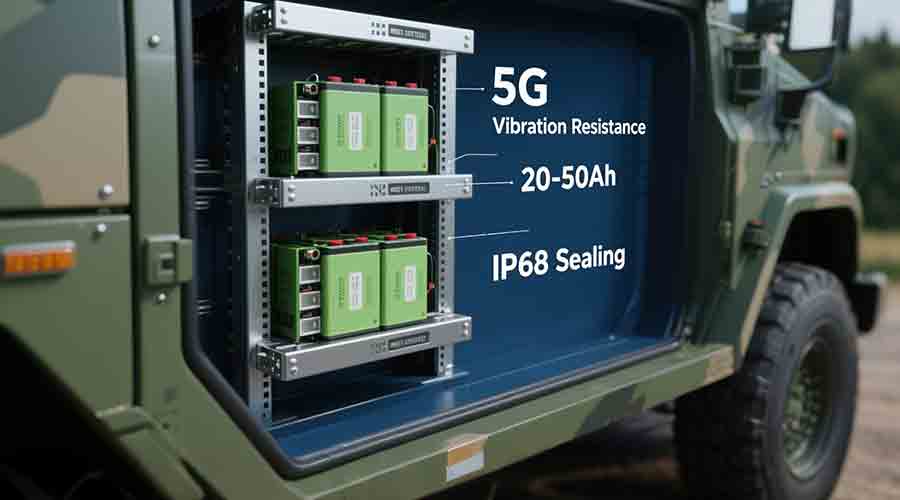
– Higher capacity (20–50Ah) modules fit into 19″ rack or MIL-STD mounting trays.
– Must withstand 5 g random vibration and repeated shock to 50 g.
3. Rapid-Deploy Emergency Kits
– Hot-swapable packs that charge in under 1 hour.
– Shelf-life of at least 18 months at 25 °C with minimal capacity fade.
2. Cell Chemistry & Pack Architecture
I typically begin by comparing Li-ion, LiFePO₄, and NiMH cells against project goals. Here’s what I look for:
– LiFePO₄ wins on thermal stability and cycle life (> 3,000 cycles), though its energy density is about 20% lower than Li-ion.
– Li-ion (NMC or NCA) offers compact packages—for handhelds, that extra 50 Wh/L can matter.
– NiMH still finds niche use in legacy systems, prized for abuse tolerance but bulky for modern gear.
At Himax, we prototype 2S2P, 4S1P, and hybrid topologies to balance voltage headroom, runtime, and EMI shielding. Modular designs allow field servicing: individual cell trays slide out for inspection without disassembling the entire pack.
3. Waterproofing, Dustproofing & Mechanical Robustness
3.1 Enclosure Materials & Seals
Marine-grade aluminum is our go-to for salt-spray resistance. We laser-weld seams and apply dual silicone O-rings to achieve IP68 (continuous immersion at 1 m for 30 minutes). For lower-volume runs, PC/ABS blends offer cost savings with respectable impact resistance.
3.2 Connector & Harness Solutions
We specify IP68-rated M12 or PG7 cable glands fitted with UV-stable TPE jacketing. In one project for an airborne radio, our custom strain-relief boots prevented seal fatigue after 1,000 flight-hour cycles.
4. Thermal Management Strategies
4.1 Passive Cooling
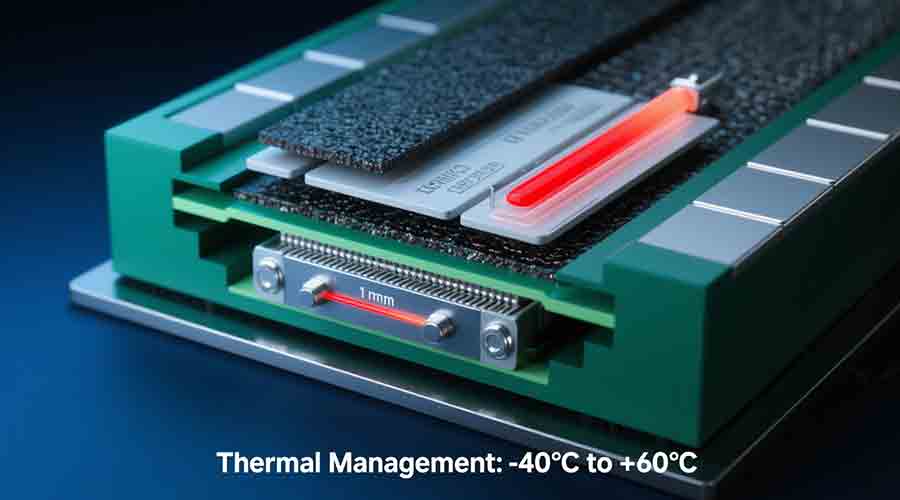
A 1 mm silicone thermal gap pad (≥ 3 W/m·K) bonded to a 0.2 mm pyrolytic graphite sheet evens temperatures across cell strings. I remember swapping a 0.5 mm pad for 1 mm—it cut peak cell temperatures by 8 °C during a 15A transmission test.
Phase-change materials (PCMs) further delay thermal spikes. We embed micro-encapsulated PCM pucks in non-critical voids so that our BMS gains precious seconds to scale back discharge under fault conditions.
4.2 Active Cooling
For vehicle-mounted repeaters drawing continuous 20A, we integrate 5 V micro-blowers controlled by the pack’s BMS. Firmware ramps fan speed when any sensor exceeds 50 °C, maintaining an optimal 40–45 °C window. In extreme cases, milled liquid-coolant channels circulate non-conductive coolant at 75 mL/min to prevent thermal runaway.
4.3 Sensor Placement & Control Logic
Our standard sensor map places NTC thermistors on the two hottest cells and one on the BMS board. We implement “turbo” mode—unrestricted current below 40 °C—and “eco” mode—limited discharge above 55 °C—to extend life and safeguard against heat damage.
MIL-STD-810G Environmental Engineering Considerations and Laboratory Tests
5. Battery Management & EMI/EMC Compliance
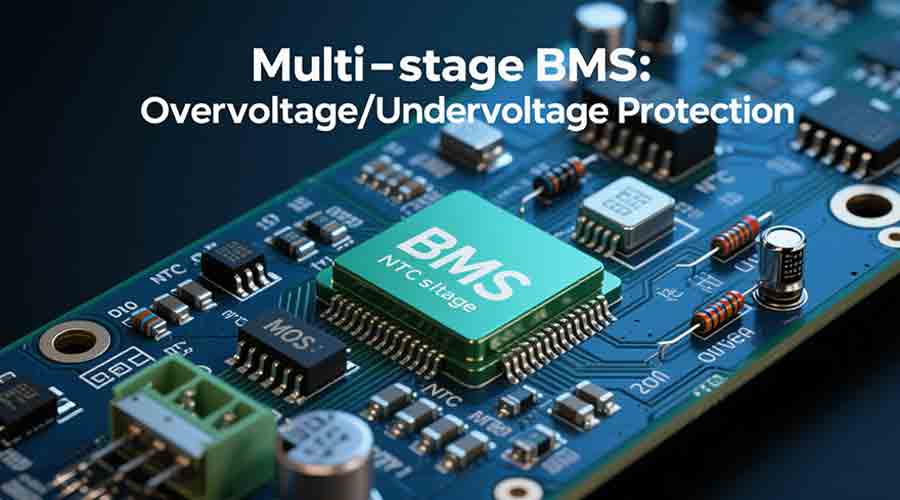
A robust multi-stage BMS is non-negotiable. At a minimum, it must detect:
– Over-voltage and under-voltage (± 50 mV accuracy)
– Short circuits in < 5 ms using MOSFET-sense resistors
– Temperature excursions via thermistor arrays
– Vibration-induced faults with onboard accelerometers
Meeting MIL-STD-461 for EMI requires careful filtering. We place ferrite beads on power leads, add EMI gaskets around seam lines, and ensure the pack’s ground plane ties into the radio chassis.
6. Certification & Testing Workflow
– MIL-STD-810G: Thermal, humidity, salt-spray, sand/dust, shock, and vibration.
– MIL-STD-461: Conducted/radiated emissions and susceptibility tests.
– UN 38.3: Air transport—altitude, vibration, shock, thermal cycling.
Himax Battery offers a one-stop testing coordination service: we handle sample prep, lab booking, and filing reports, so your team can focus on system integration rather than logistics.
7. Real-World Case Study
Client: Mountain rescue unit requiring a VHF radio pack that survives alpine storms.
– Specs: 7.2 V, 4 Ah LiFePO₄ 2S2P pack
– Build: Aluminum IP67 housing, full epoxy-potted BMS electronics, silicone thermal bridge
– Results: Passed 72 h salt-spray, 30 min immersion, and 1,200 thermal cycles (–40 °C to +60 °C). Users reported zero failures after six months of field use.
“That pack outperformed our expectations in both cold and wet climates,” said the lead SAR engineer.
Designing batteries for military and emergency communication systems demands meticulous attention to chemistry, packaging, thermal control, and compliance. By leveraging Himax Battery’s expertise in rugged enclosure design, multi-stage BMS, and one-stop certification services, you’ll accelerate development and field performance.
Ready to prototype your next MIL-STD/IP68 battery pack?
Email us at services@himaxelectronics.com or complete our Rapid-Quote Form for a turnkey proposal.