The rectangular 9-volt battery is an iconic piece of portable power technology. It’s ubiquitous, found in everything from critical smoke detectors to professional audio equipment. But despite its commonality, there is widespread confusion about its actual power capabilities.
When people ask about “9V battery amps,” they are often asking two different things simultaneously: “How much energy does it hold?” and “How fast can it deliver that energy?”
Understanding the difference is crucial. Choosing the wrong chemistry for a high-drain device won’t just result in short runtimes; it can cause performance failures due to voltage sag. At Himax Battery, we engineer advanced energy solutions, and we believe understanding the science behind the cell is the first step to reliable power.
This guide will break down the complex relationship between voltage, amps, and chemistry in the 9V form factor.
The Basics: Amps (Current) vs. Amp-Hours (Capacity)

Before diving into specific battery types, we must clarify the terminology. It is easy to confuse “Amps” with “Amp-hours” (or milliamps and milliamp-hours), but they measure completely different things.
Voltage (V): The Pressure
Think of voltage as water pressure in a pipe. A 9V battery provides a standard amount of electrical “pressure.”
Amperage (Amps/mA): The Flow Rate
Amps measure the current—the actual volume of electricity flowing at any given moment. This is what we mean when we talk about a device’s “draw.”
- A smoke detector “sips” power (very low amps).
- A professional wireless microphone transmitter “gulps” power (higher amps).
Milliamp-Hours (mAh): The Tank Size
This is capacity. A rating of 500 mAh means the battery could theoretically provide 500 milliamps of current for one hour before dying (or 100mA for 5 hours).
The crucial point: Just because a battery has a large “tank” (high mAh) doesn’t mean it has a wide “pipe” (high Amps). Internal resistance within the battery dictates how fast power can be delivered.
Chemistry Matters: A Breakdown of 9V Amp Ratings
The “9V” on the label only tells you the voltage. The chemistry inside determines the amperage capability.
1. Carbon-Zinc (Heavy Duty) & Alkaline: The Old Guard
These are the most common disposable 9V batteries. They rely on older chemical reactions that have high internal resistance.
- The Amp Reality: Alkaline batteries are excellent for very low, intermittent draws (like a smoke alarm that sits idle 99% of the time). However, ask them for high amps, and their voltage collapses instantly.
- Typical Max Continuous Discharge: Often limited to under 50mA to 100mA before significant voltage sag occurs. If you put an alkaline 9V in a high-drain toy, it might feel “dead” quickly even though it still has capacity left—it just can’t deliver the amps fast enough.
2. Nickel-Metal Hydride (NiMH): The Rechargeable Workhorse
NiMH 9V batteries are popular reusable options. They generally have lower internal resistance than alkaline, allowing for higher current draw.
- The Amp Reality: They can handle moderate loads better than alkaline, often sustaining 200mA–300mA draws.
- The Caveat: True NiMH “9V” batteries are rarely actually 9 volts. They are typically composed of roughly seven 1.2V cells connected in series, resulting in a nominal voltage of 7.2V or 8.4V. While sufficient for many devices, some sensitive electronics may read them as “low battery” right off the charger.
3. Lithium-Ion (Li-ion): The High-Performance Shift
This is where modern battery technology, the kind utilized in advanced Himax solutions, takes over. Modern rechargeable 9V Li-ion batteries usually contain two 3.7V lithium cells and sophisticated internal circuitry to regulate the output to a steady 9V.
- The Amp Reality: Lithium chemistry offers exceedingly low internal resistance. This means they can deliver high amperage continuously without severe voltage drop until the battery is nearly depleted.
- Typical Max Continuous Discharge: High-quality Li-ion 9V batteries can often sustain outputs of 500mA or even up to 1A (1000mA) depending on the design and Battery Management System (BMS). This makes them vastly superior for high-drain electronics.
Comparative Data: 9V Chemistries at a Glance
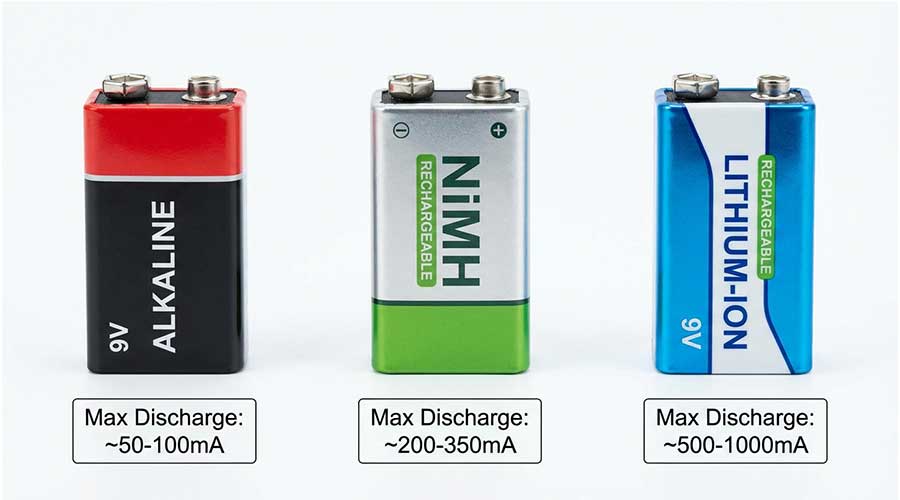
The following table provides typical ranges for standard commercial 9V batteries. Note that professional-grade industrial cells may exceed these specifications.
| Battery Chemistry | Typical Voltage (Nominal) | Typical Capacity Range (mAh) | Estimated Max Continuous Discharge (mA) | Ideal Application |
| Carbon-Zinc (Disposable) | 9V | 300 – 400 mAh | < 50 mA | Clocks, basic remotes. |
| Alkaline (Disposable) | 9V | 500 – 600 mAh | 50 – 100 mA | Smoke detectors, multimeters. |
| NiMH (Rechargeable) | 7.2V – 8.4V | 175 – 300 mAh | 200 – 350 mA | Wireless mics, older toys. |
| Li-ion (Rechargeable) | 9V (Regulated) | 400 – 800+ mAh | 500 – 1000 mA | Medical devices, pro audio, high-drain tech. |
Note: Data points are general industry averages and vary significantly by manufacturer and specific product design.
Real-World Applications: Why Amps Matter

Why does a 600mAh alkaline battery die faster in a high-tech device than a 500mAh lithium battery? It’s all about the amps.
High-Drain Devices (Where Amps are Critical)
Devices like professional wireless audio transmitters, medical TENS units, high-end paintball markers, or active guitar pickups require steady, strong current.
If you use an alkaline battery here, the high amp demand causes its voltage to drop below the device’s operating threshold rapidly. The device shuts off, even though the battery might still be 60% full chemically. A high-amp Lithium-Ion battery will maintain voltage under that same load, utilizing nearly its entire capacity.
Low-Drain Devices
For a smoke detector or a wall clock that pulses microseconds of current occasionally, high amp capability is irrelevant. In these cases, self-discharge rate and shelf life are more important than instantaneous power delivery, making quality alkaline batteries a sufficient choice.
Conclusion: Matching Power to the Task
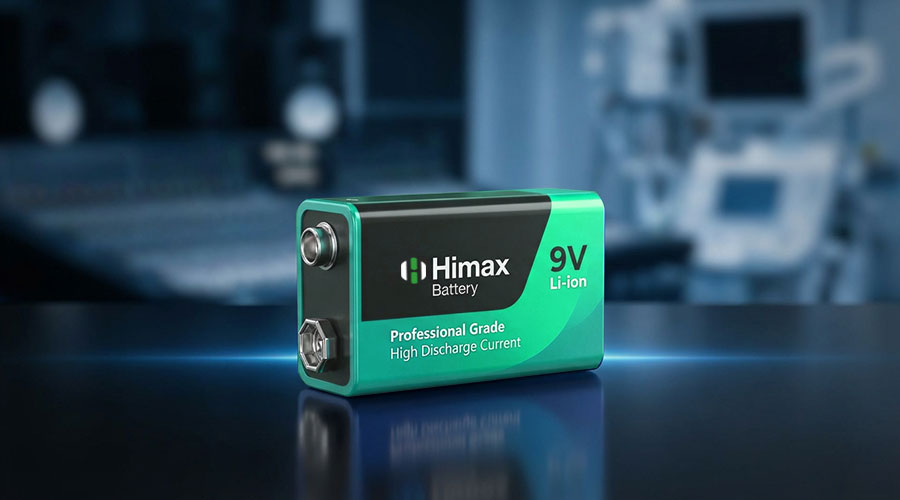
When sourcing 9V batteries, looking solely at the price tag or the mAh rating is a mistake. You must know the current draw (amps) of your application.
As devices become more sophisticated, their power demands increase. The trend in professional and industrial sectors is moving rapidly toward high-discharge lithium solutions that offer consistent voltage under load. At Himax Battery, we specialize in understanding these demanding power profiles to ensure your devices operate at peak performance, rather than being throttled by outdated battery chemistry.
Find articles related to 9V Battery Pack