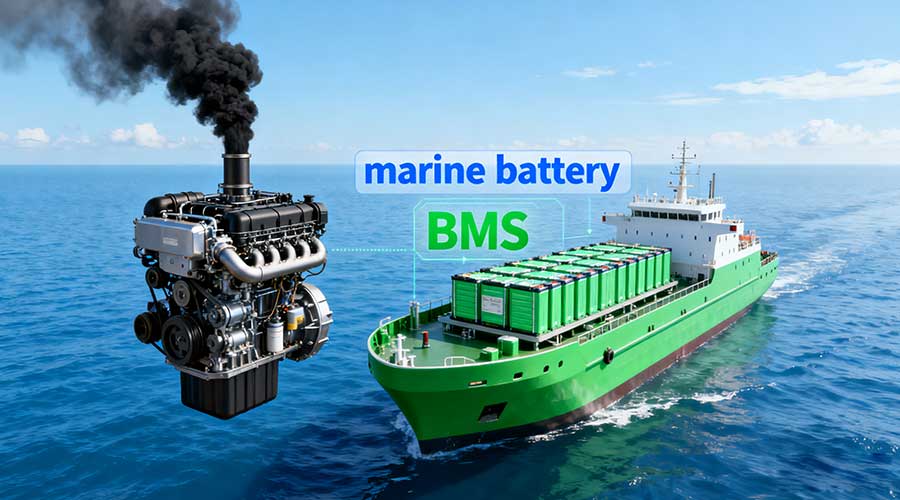
The sea is changing. Ships used to run on fuel alone. Now many pair engines with stored energy. At the center of that change is the marine battery. It stores energy, feeds propulsion, and runs hotel loads and electronics. A good battery keeps a vessel moving and keeps the crew safe.
Along the way, I will use related terms in bold for clarity and SEO: marine battery, deep-cycle battery, LiFePO4, lithium-ion battery, battery bank, Battery Management System (BMS), cycle life, depth of discharge (DoD), round-trip efficiency, and shore power integration.
What is a deep-cycle marine battery?
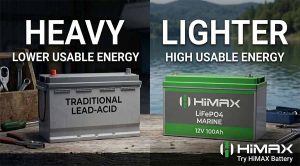
A deep-cycle battery is built to deliver steady power for long periods. It is not a starter battery. Starter batteries give short, high-current bursts. Deep-cycle batteries give continual current and tolerate deep discharge. Typical marine chemistries include LiFePO4 and other lithium-ion battery types. These chemistries offer long cycle life, higher usable DoD, and lighter weight than lead-acid.
Why batteries matter in modern shipping
A marine battery changes how a ship uses energy. It reduces fuel use, lowers emissions, and makes systems more responsive. Picture the ship as a body: the engine is the muscle, the battery is the heart. Without a steady heart, the body tires quickly. Who wouldn’t want a calmer, cleaner voyage?
Key benefits, plain and simple — expanded with concrete examples
Below are the main benefits spelled out with measurable examples so buyers and operators can make clear comparisons.
1) Lower fuel consumption and emissions

· Real-world example: a hybrid harbor ferry that replaces low-speed diesel cruising with battery power can cut fuel use by 20–40% on short runs.
· Sizing example: if a ferry’s hotel loads are 2 kW for 4 hours daily (8 kWh/day), switching to batteries and shore charging can eliminate the small diesel generator runtime that otherwise burns roughly 0.6–1.2 gallons of diesel per day (depending on generator efficiency).
· Parameter note: reduce engine idle hours and you reduce CO₂, NOx, and particulate emissions immediately.
2) Improved responsiveness and system performance
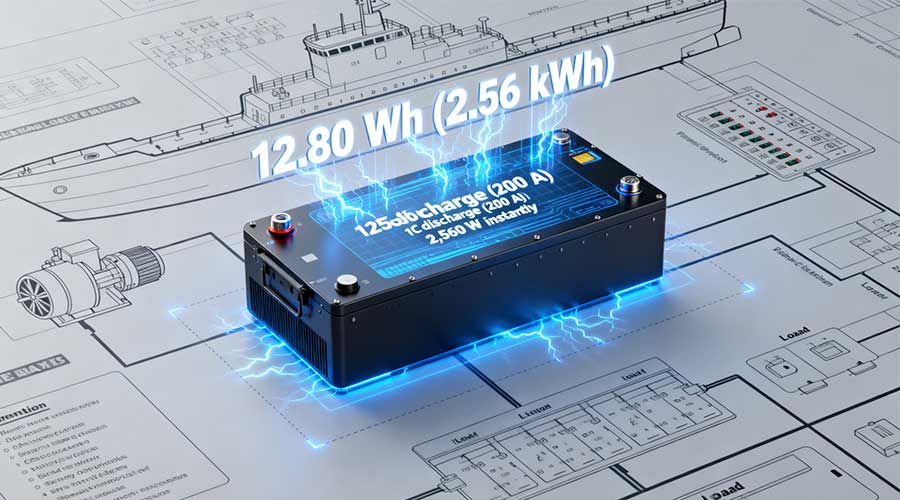
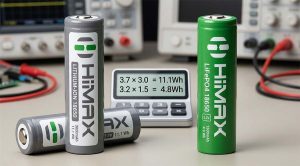
· Instant power example: a 12.8V 200Ah LiFePO4 module stores 12.8 V × 200 Ah = 2560 Wh (2.56 kWh). At 1C discharge (200 A), it can deliver 2,560 W instantly for short durations.
· Peak assist example: pairing a 48V 100Ah module (4.8 kWh) with a generator lets batteries supply peak loads quickly while the generator runs at an efficient steady state. The battery answers high power demands in milliseconds — engines take seconds to spool up.
3) Quieter operations and better onboard comfort
· Decibel difference: electric drive and battery-only hotel loads typically cut noise by several decibels compared with diesel gensets. Quiet matters in harbors and for wildlife.
· Passenger experience: a silent approach to a dock feels like gliding instead of coughing into the wind. That’s a tangible commercial advantage for tour operators.
4) Longer useful life and better total cost of ownership (TCO)
· Cycle life comparison: LiFePO4 cells commonly reach 3,000–6,000 cycles at 80% DoD. Lead-acid typically offers 300–500 cycles at 50% DoD.
· DoD example: a LiFePO4 pack rated 100 Ah at 12.8 V (≈1.28 kWh usable at 100% capacity) with safe DoD of 80% yields 1.024kWh usable each cycle. Over 3,000 cycles, usable throughput far exceeds lead-acid.
· Warranty and lifespan: typical warranties for marine LiFePO4 packs range 5–10 years, and practical lifetimes often exceed 10 years in proper systems. Upfront cost is higher, but lifecycle cost often ends up lower.
5) Faster and more efficient energy flows
· Round-trip efficiency: modern lithium-ion packs (including LiFePO4) often show 90–95% round-trip efficiency. Lead-acid systems are often 70–85%. That means less energy lost during charge/discharge cycles.
· Energy density and weight: LiFePO4 energy density commonly sits around 90–120 Wh/kg. For example, a 2.56 kWh pack at 100 Wh/kg weighs about 25.6 kg. Lower weight improves vessel payload and fuel use.
6) Charging time examples and safe charge rates
· Charger sizing: a 48 V 100 Ah pack stores 4.8 kWh. Charging at 0.2C (20 A at 48 V = 960 W) takes 4.8 kWh ÷ 0.96 kW = 5 hours. Charging at 0.5C (50 A = 2.4 kW) takes 4.8 kWh ÷ 2.4 kW = 2 hours.
· Practical constraint: many marine systems limit charging to ≤0.5C for battery health unless the pack and cooling are explicitly designed for higher rates.
7) Thermal and environmental specs to check
· Operating range: quality LiFePO4 marine packs commonly operate from -20°C to +60°C, but charging below 0°C often requires battery heating to avoid lithium plating.
· Ingress and mechanical protection: look for marine enclosures rated for spray and salt air, and vibration-tested mounting to reduce fatigue.
8) BMS capabilities and communications
· Essential BMS functions: cell balancing, over/under voltage protection, overcurrent cutoff, temperature cutoffs, state-of-charge (SoC) estimation, and fault logging.
· Telemetry: CANbus, RS485, or Ethernet reporting allows fleet operators to monitor SoC, cycles, voltages, and temperatures remotely.
9) Sizing example for practical loads
· Hotel loads scenario: 1 kW hotel load for 8 hours = 8 kWh needed.
oUsing 12.8V 200Ah modules (2.56 kWh each), you’d need 4 modules: 4 × 2.56 kWh = 10.24 kWh usable pack, giving a comfortable margin.
oUsing 48V 100Ah modules (4.8 kWh each), you’d need 3 modules (14.4 kWh) to have margin and allow healthier DoD.
10) Economics and TCO in example terms
· Example calculation (simplified): if a LiFePO4 system lasts 5–10× longer than lead-acid and saves 20–40% fuel annually, the payback window can be 2–6 years depending on fuel cost, duty cycle, and initial premium. Run your mission profile numbers.
Common use cases on vessels
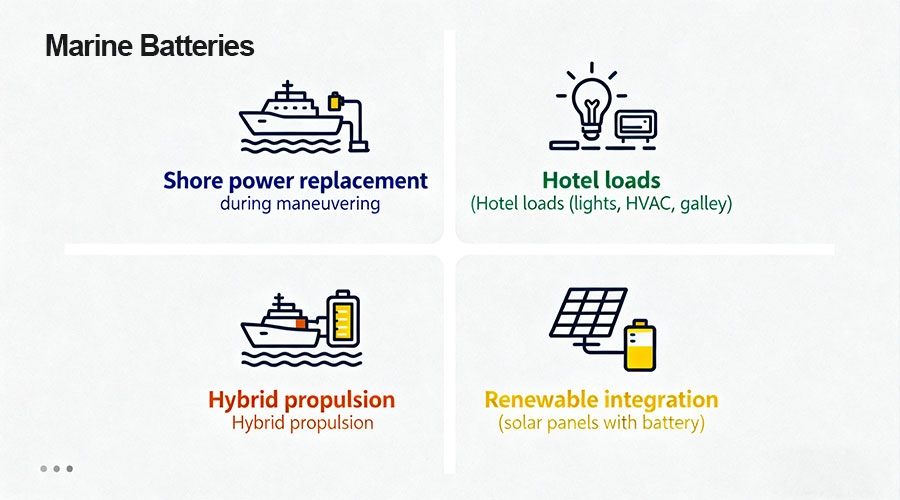
· Shore power replacement during maneuvering.
· Hotel loads: lights, HVAC, galley, navigation gear.
· Hybrid propulsion: batteries assist engines at peaks.
· Electric-only short trips for ferries and water taxis.
· Renewable integration: batteries store solar or wind energy for later use.
Technical criteria to evaluate
· Capacity (Ah) and usable energy (kWh).
· Voltage compatibility with your system (12 V, 24 V, 48 V).
· Continuous and peak discharge capability (C-rate).
· Cycle life at target DoD.
· Weight per kWh (Wh/kg) and volume.
· Thermal management and BMS features.
· Certifications and marine-grade enclosures.
Safety: design for the worst, hope for the best
A good BMS is a watchdog. It balances cells, stops overcharge, and isolates faults. Install fuses, remote disconnects, and adhere to certified installation practices. Treat the battery with respect — it holds a lot of energy.
Purchasing guidance: what to ask suppliers
Ask about cell chemistry, usable capacity at your target DoD, cycle life, included BMS protections, enclosure ratings, charging specs, and warranty/support. Request marine references and test data. If a seller dodges specific numbers, find another seller.
Installation best practices
· Mount near center of gravity.
· Use marine-grade cables and secure mounts.
· Separate starter and house systems unless properly isolated.
· Add a visible master disconnect and accessible fuses/breakers.
· Integrate BMS telemetry into vessel monitoring.
Charging strategies: shore, regenerative, and on-board
· Shore power integration with a smart charger is simple and effective.
· Regenerative charging recovers energy in hybrid systems.
· On-board charging uses efficient engine operation to refill batteries.
Always respect thermal and charge rate limits controlled by the BMS.
Maintenance and monitoring
· Check terminal torque and connections.
· Monitor SoC, voltage, and temperature via BMS.
· Cycle batteries periodically if idle.
· Update firmware for chargers and BMS when available.
Economics: upfront cost vs. lifecycle value
Batteries are an investment. Compare purchase price, cycle life, maintenance, fuel savings, and downtime reductions. A higher upfront price can mean lower cost over a fleet lifecycle.
Environmental impact and sustainability
Switching to battery-backed operation reduces direct emissions and noise. Paired with renewables or shore power from clean grids, the carbon impact falls further. Consider supplier recycling programs and end-of-life plans.
Real-world examples and models
· Short-route electric ferries that recharge at terminals.
· Tourist vessels prioritizing quiet, emission-free cruising.
· Hybrid workboats using batteries for hotel loads and peak assist.
Future trends
Expect higher energy densities, faster safe charge protocols, modular banks for staged upgrades, and software-defined energy management that turns fleets into intelligent microgrids.
Practical buyer checklist
- Define mission profile: range, hotel loads, peak demand.
- Choose chemistry for safety, weight, and lifecycle.
- Confirm BMS capabilities and diagnostics.
- Require marine-grade testing and vibration proofing.
- Ask for references from similar vessels.
- Plan for recycling/end-of-life.
FAQs (short)
Q: How long will a marine battery last?
A: It depends on chemistry and use. LiFePO4 can last thousands of cycles with proper care.
Q: Can I retrofit my boat?
A: Usually yes. Work with a qualified marine electrician and confirm weight and space.
Q: Is a BMS necessary?
A: Absolutely. It protects cells and reports faults.
Conclusion
Batteries are not a silver bullet, but they are a powerful partner. A marine battery shifts how we think about energy at sea. It enables quieter operation, lower emissions, and smoother power delivery. Choose the right chemistry, integrate protections, and maintain the system well. The result is cleaner, safer, and more efficient voyages.
Would you rather cross the harbor amid engine clatter, or glide quietly with stored energy humming beneath your feet? The answer points the way.
About HiMAX Battery
HiMAX Battery is one of the world’s efficient new-energy custom battery brands. We are factory-direct to customers, which removes middleman markups and speeds delivery. HiMAX covers multiple chemistries, including LiFePO4, lithium-ion battery, lithium polymer (LiPo), and nickel-metal hydride (NiMH). We provide high-efficiency personalized customization for voltage, capacity, discharge current, and physical dimensions. Our process is fast: design drafts in three days and sample delivery within seven days — faster than the industry average. First-time customers can receive free samples on their initial order. For custom marine battery solutions, HiMAX offers factory pricing, engineering support, and rapid prototyping to get you sailing sooner.