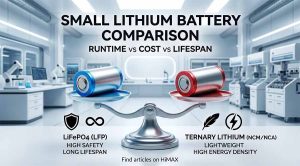
With the rise of portable electronics, power tools, and smart devices, small lithium batteries are increasingly used in everyday life. The two main battery technologies are Lithium Iron Phosphate Batteries (LiFePO4) and Ternary Lithium Batteries (NCM/NCA).
Many users wonder: Which battery lasts longer? Which is more durable? What is the long-term cost? This guide provides a comprehensive comparison from multiple dimensions: runtime, lifespan, cost, safety, and real-world applications to help you choose the right battery solution.
What Are Small Lithium Iron Phosphate Batteries and Ternary Lithium Batteries?
Before comparing, let’s look at the material structure of each battery type:
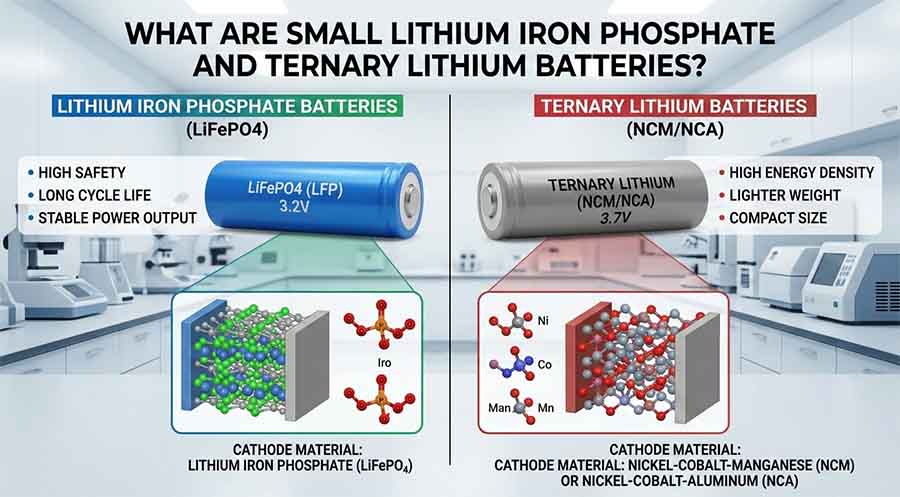
Lithium Iron Phosphate Batteries (LiFePO4)
- Cathode material: Lithium Iron Phosphate (LiFePO4)
- Advantages: high safety, long cycle life, stable power output
- Ideal for applications needing durability and stability
Ternary Lithium Batteries (NCM/NCA)
- Cathode material: nickel-cobalt-manganese (NCM) or nickel-cobalt-aluminum (NCA)
- Advantages: high energy density, lighter weight, compact size
- Ideal for applications needing long runtime in lightweight devices
Summary Table:
| Feature | Lithium Iron Phosphate (LiFePO4) | Ternary Lithium (NCM/NCA) |
| Safety | High | Moderate |
| Energy Density | Medium | High |
| Weight | Heavier | Lighter |
| Lifespan | Long | Medium |
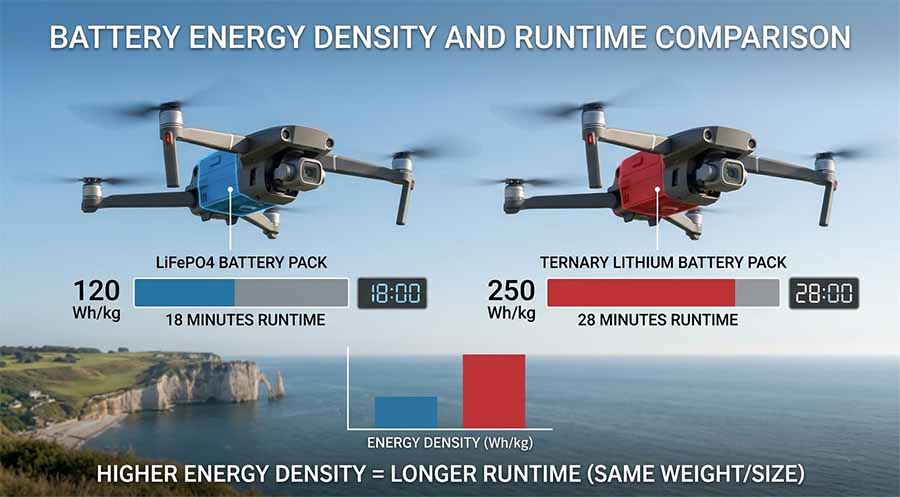
- Ternary Lithium Batteries usually provide higher energy density under the same size or weight.
- Higher energy density = more stored power per unit volume.
Example: 12V 5Ah Battery Pack
| Battery Type | Weight | Runtime |
| Ternary Lithium | 600g | 6 hours |
| LiFePO4 | 850g | 6 hours |
Devices sensitive to weight or size (drones, handheld electronics, portable devices) benefit from Ternary Lithium Batteries for longer runtime.
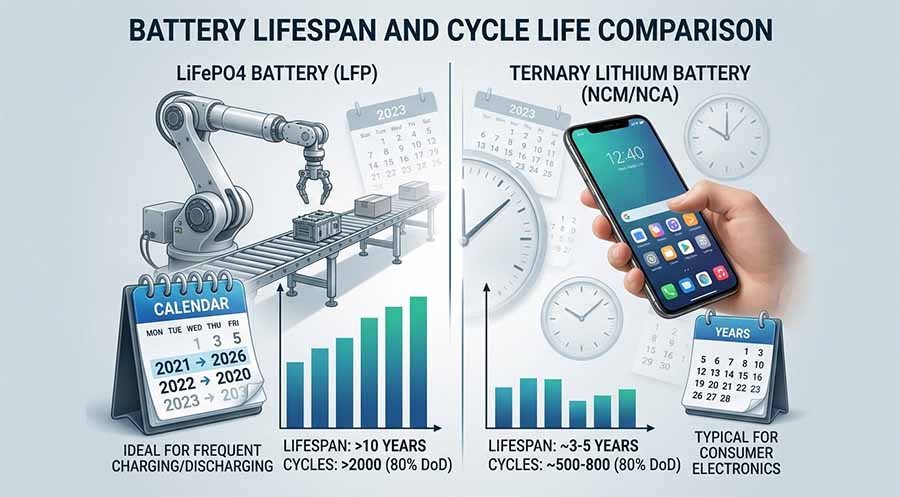
- LiFePO4 batteries excel in cycle life.
- Frequent charging/discharging devices (energy storage, power tools, robots) perform better with LiFePO4.
Example: Daily Use
| Battery Type | Expected Lifespan |
| Ternary Lithium | 2–3 years |
| LiFePO4 | 5–8 years |
LiFePO4 batteries offer lower overall costs in long-term applications.
- Initial cost: Ternary Lithium slightly cheaper
- Total Cost of Ownership (TCO) favors LiFePO4 due to:
- Longer cycle life → fewer replacements
- Higher stability → lower maintenance
- Better thermal stability → lower safety risks
Example: Daily-charging device
| Battery Type | Replacement Interval |
| Ternary Lithium | 2 years |
| LiFePO4 | 5+ years |
Industrial equipment, energy storage, and robotic devices increasingly choose LiFePO4 batteries for cost-efficiency.
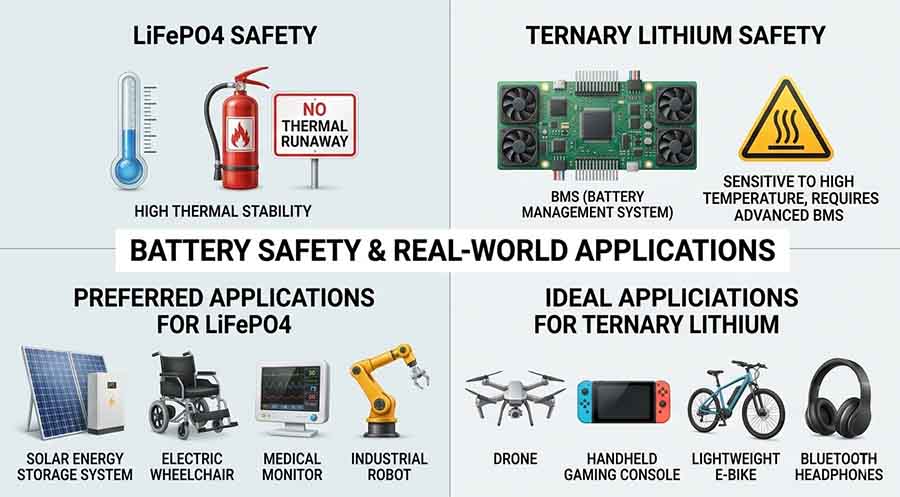
- LiFePO4: high thermal stability, less prone to thermal runaway, safe under high temperature or overcharge
- Ternary Lithium: sensitive to high temperature, requires complex BMS for safety
Preferred Applications for LiFePO4:
- Energy storage systems
- Electric wheelchairs
- Medical devices
- Industrial robots
Scenario 1 – Portable Fish Finder
- Location: Florida, USA
- Device: 12V, 24W portable fish finder, runtime 6 hours
| Battery Type | Weight | Runtime | Notes |
| Ternary Lithium 6Ah | 650g | 6 hours | Lightweight preferred |
| LiFePO4 6Ah | 900g | 6 hours | Longer cycle life |
Scenario 2 – Electric Lawn Mower Backup
- Location: Texas, USA
- Device: 24V, 350W, 40min runtime
| Battery Type | Expected Cycles |
| Ternary Lithium 10Ah | 800 |
| LiFePO4 10Ah | 3000 |
Scenario 3 – Mobile Surveillance System
- Location: California, USA
- Device: 12V, 12W total power
| Battery Type | Runtime | Cycle Life |
| LiFePO4 10Ah | 10 hours | 3000+ |
Long-term outdoor operation favors LiFePO4 batteries for stability.
How to Choose the Right Small Lithium Battery
Choose Ternary Lithium if:
- Weight and size are critical
- High energy density is needed
- Device usage is infrequent
Choose Lithium Iron Phosphate if:
- Long-term cycling required
- Safety is a priority
- Operating environment is complex
There is no absolute best choice—select based on real-world application needs.
HiMAX is a global leader in high-performance lithium battery technology. They offer:
- LiFePO4 batteries
- Ternary Lithium batteries
- Custom battery modules
HiMAX Batteries advantages:
- High safety
- Stable output
- Long cycle life
Applications: robotics, smart electronics, energy storage, power tools, portable devices.
For reliable small lithium battery solutions, HiMAX provides stable, efficient, and durable power for your devices.
Find articles related to Battery Comparison Tips on HiMAX
- Lithium vs Lead Acid Batteries for Electric Wheelchairs
- Battery Cell vs Battery Pack: What’s the Difference
- Price Comparison of 6 Common Lithium-Ion Battery Voltages (3.7V–22.2V)
- Waterproof Battery vs Regular Battery: What’s the Difference?
- Comparing Lithium-Ion Battery Needs: Consumer Electronics vs EV